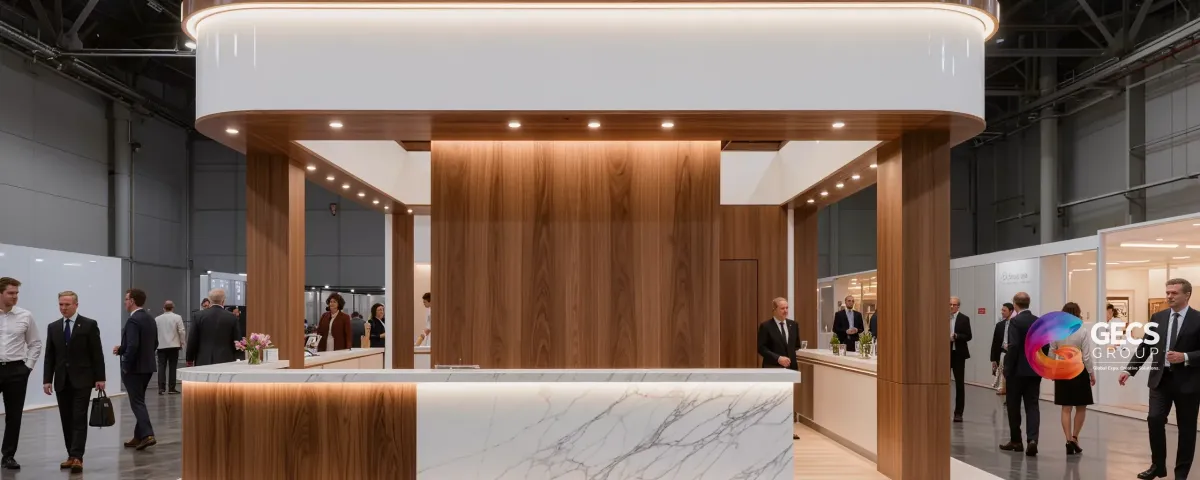
How an Italian stand builder works at European trade shows: production in Italy, transport, build-up crews, venue rules, costs and comparison with local builders.
For many companies the most important show of the year is not in Italy: it is in Frankfurt, Düsseldorf, Munich, Paris, Barcelona, Amsterdam or London. When exhibiting abroad, the question is always the same: is it better to rely on a local stand builder, who knows the venue and doesn't have to travel, or an Italian stand builder, who produces in Italy and brings the stand with its own crews? There is no answer that fits everyone, but there are concrete reasons why more and more companies, foreign ones included, choose a stand built in Italy.
In this guide we explain how an Italian stand builder works at European shows: quality and materials, production, transport, travelling crews, venue rules, costs and comparison with local builders. For the general organisational side of exhibiting abroad, see also our guide to stands for shows abroad.
In short: an Italian stand builder offers Made in Italy quality (wood, lacquers, marble, finishing details), a carefully crafted design and a single point of contact from design to dismantling. Transport and travel add costs, but are often offset by more competitive production prices and by reusing the stand at several shows. You need a partner who knows the regulations and paperwork of foreign venues well.
1. Why choose an Italian stand builder

The first reason is perceived quality. Around the world, “Made in Italy” means attention to detail, natural materials, a sense of proportion and finish. For an Italian company exhibiting abroad, a stand built in Italy is consistent with its brand: it tells the same story of quality as the products. But German, French and Middle Eastern companies also choose Italian stand builders for exactly this reason, especially in furniture, fashion, design, food and luxury.
The second reason is communication. Working in your own language, with a contact who knows the company, simplifies briefs, revisions and decisions. The third is continuity: the same stand builder can handle shows in Italy and abroad, reusing structures, furniture and graphics and keeping a consistent image across all the year's events.
Finally there is value for money. In many Northern European countries hourly labour and production costs are higher than in Italy: even adding transport and travel, a stand produced in Italy can be competitive for the same quality.
2. Production in Italy: materials and craftsmanship

The heart of the work is the workshop. In Italy, and especially in the North-East, there is a unique supply chain of joiners, lacquerers, metal, marble and glass workers, printers and lighting technicians. A stand builder rooted in the area, as we are in Padua, can rely on this network to make custom elements that would be difficult or expensive elsewhere.
Typical work includes CNC-milled wood and MDF panels, matt and gloss lacquers in any colour, fine wood veneers, marble, quartz or solid-surface tops, steel and aluminium structures, graphics printed on fabric and rigid panels. The most complex elements are pre-assembled in the workshop to check dimensions and joints before departure: no surprises at the show and a faster build-up. For details on materials, see our guide to Made in Italy custom furniture.
The stand is also designed with the journey in mind: modular elements, sizes compatible with the vehicles, quick fixing systems, custom packaging reused on the way back.
3. Transport in Europe

Transport is the part that most worries people who have never organised it, but for a stand builder used to working abroad it is routine. From Northern Italy the main European shows can be reached in one or two days: Munich and Verona are close, Frankfurt, Düsseldorf, Cologne, Paris and Lyon take one or two days, Barcelona and Madrid two days. Dedicated trucks and articulated lorries are used, leaving with the stand packed in build-up order.
Within the European Union there are no customs, but you need to consider weekend and public-holiday driving bans for heavy goods vehicles, which differ from country to country, and crossing times at Alpine passes. Switzerland and the United Kingdom require customs procedures, often with an ATA carnet for temporary import. All the details are in our guide to stand transport and logistics.
4. Travelling build-up crews

The stand arrives at the show together with the crew that saw it being made. It is one of the most concrete advantages: the installers know every element, how it fits together and how to solve small surprises, and can carry out finishing touch-ups on site. A crew leader coordinates the work, talks to the venue technicians and is the exhibitor's point of reference.
Travelling crews work with the documents foreign venues require: staff registration, safety certificates, insurance cover. In some countries, such as Germany, site safety checks are very strict; in others, such as the Gulf states, specific passes and permits are needed. Our team has build-up experience throughout Europe, the United Kingdom, the UAE and Saudi Arabia.
The crew's travel, meals and accommodation are part of the quote and must be shown clearly. For shows close to the Italian border, such as Munich or Lugano, the impact is limited; for distant shows it pays to optimise the days on site.
5. The rules of European exhibition centres

Each venue has its own technical regulations, and abroad the differences from Italy can be significant. In Germany many shows require structural documentation for stands above certain heights and closely check the fire rating of materials; in France forms and procedures for electrical installations differ; in the United Kingdom specific rules apply to site safety and double-deck structures. Deadlines for submitting designs are often earlier than in Italy.
| 🌍 Country | 🏛️ Main shows | 📌 What to know |
|---|---|---|
| 🇩🇪Germany | Frankfurt, Düsseldorf, Cologne, Munich, Nuremberg | Structural documents and very strict checks |
| 🇫🇷France | Paris, Lyon, Cannes | Specific procedures for electrics and materials |
| 🇪🇸Spain | Madrid, Barcelona, Valencia | Compressed build-up hours |
| 🇳🇱Netherlands | Amsterdam, Utrecht | Strong focus on sustainability and waste |
| 🇬🇧United Kingdom | London, Birmingham | Customs and specific safety rules |
| 🇨🇭Switzerland | Basel, Geneva, Zurich | Customs and authorisations for foreign companies |
A good stand builder reads the regulations in the original language, prepares documents in the required format and keeps in touch with the show's technical office. For the exhibitor the work is the same as for a show in Italy: approve the design and arrive at a ready stand. For the general principles, see our guide to trade show technical regulations.
6. Costs and comparison with local stand builders

The comparison between an Italian and a local stand builder should be made on total cost, not on a single item. The local builder has no transport or travel costs, but often higher production and labour costs. The Italian builder adds transport, travel and accommodation, but produces at more competitive costs and, if the stand is reused at several shows, amortises the investment better.
| 🧾 Item | 🇮🇹 Italian stand builder | 🌍 Local stand builder |
|---|---|---|
| 📐Design | In Italian, same contact for all shows | In the local language or English |
| 🏭Production | Made in Italy, competitive costs | Often more expensive in Northern Europe |
| 🚚Transport | To be added, 1–2 days within Europe | Minimal |
| 👷Build-up | Crew that knows the stand | Local crews |
| 🏨Travel | Travel and accommodation to factor in | None |
For a 50–80 m² stand in Germany, the difference between the two solutions is often smaller than expected, while the difference in quality and control over the result can be large. For reference prices, see our guide on how much an exhibition stand costs.
💬 Exhibiting in Germany, France, Spain or the UK? Send us the show, size and dates: we will propose the design, production in Italy and build-up with our own crews. Ask for a quote abroad →
How remote collaboration works
Many foreign clients never visit our workshop before the show: everything happens remotely, with a proven method. It starts with a video call for the brief, the show floor plan and regulations are shared, the concept and 3D views are delivered and revisions are discussed online. For important choices we send material samples by courier: woods, lacquers, printed fabrics.
During production the client receives photos and videos of the elements being made and of the pre-assembly in the workshop. On build-up day the crew leader sends updates from the hall, and on the evening before opening the hand-over inspection is done together. This way of working suits both Italian companies exhibiting abroad and foreign companies who want a Made in Italy stand at their own national shows.
What to ask a stand builder for shows abroad
Before entrusting a stand for a show abroad, it is worth asking a few precise questions. The answers say far more than a portfolio of nice photos, because they show whether the stand builder really has experience outside Italy and can handle surprises far from their own workshop.
- Which venues have you already built at? Experience at the same venue, or at least in the same country, greatly reduces risks around regulations, hours and services.
- Are the crews your own? Employed crews or regular collaborators know how the company works; crews found locally at the last minute don't.
- Who prepares the documents for the show? Design, calculations, material certificates, staff registration: these must clearly be the stand builder's tasks.
- How do you handle transport and customs? Own vehicles or trusted forwarders, travel times, ATA carnet for non-EU countries.
- What happens if a part is missing at the show? A good stand builder brings spares, has contacts with local suppliers and knows how to find quick solutions.
- What insurance cover do you have abroad? Liability insurance must also be valid in the countries where you work.
The quote also says a lot: a complete quote for abroad shows production, transport, build-up, travel, venue services and paperwork separately, so it can be compared with a local stand builder's offer. For a full list of what to check before signing, see our guide to the stand builder contract and insurance.
Mistakes to avoid
- Comparing only the structure price. Transport, build-up and services make the difference.
- Starting late. Abroad, regulation deadlines are often earlier.
- Underestimating the paperwork. Forms, certificates and permits change from country to country.
- Ignoring driving bans. A truck stuck over the weekend can derail the build-up.
- Crews without experience abroad. Safety rules at foreign venues are strict.
- No reuse plan. A stand designed for a single show abroad costs more.
Frequently asked questions
Quick answers to the questions we hear most often
Do you also work for foreign companies?
Yes, we also build Made in Italy stands for foreign companies, at their national and international shows.
In which countries do you build stands?
Throughout Europe, the United Kingdom, Switzerland and the Middle East, including the UAE and Saudi Arabia.
How early should we contact you for a show abroad?
At least four or five months before for a custom stand, more for large or double-deck stands.
Do your crews speak English?
Yes, crew leaders communicate in English with venue technicians and foreign clients.
Can the stand be reused at shows in different countries?
Yes, we design modular structures that adapt to different sizes and regulations, changing graphics and some elements.
Who handles the paperwork with foreign shows?
We do: design, technical documents, certificates and crew registration.
Does a stand produced in Italy cost more abroad?
Not necessarily. Transport and travel are added, but production in Italy is often more competitive than in Northern Europe, and reusing the stand at several shows lowers the cost per event.
Can you also coordinate local services such as hostesses and catering?
Yes, we work with trusted suppliers in the main European exhibition cities and can coordinate these services together with the stand.

Want a Made in Italy stand at your next European trade show?
We design and produce in Padua, transport with dedicated vehicles and build with Italian crews all over Europe, the UK and the Middle East, with a single point of contact from start to finish.