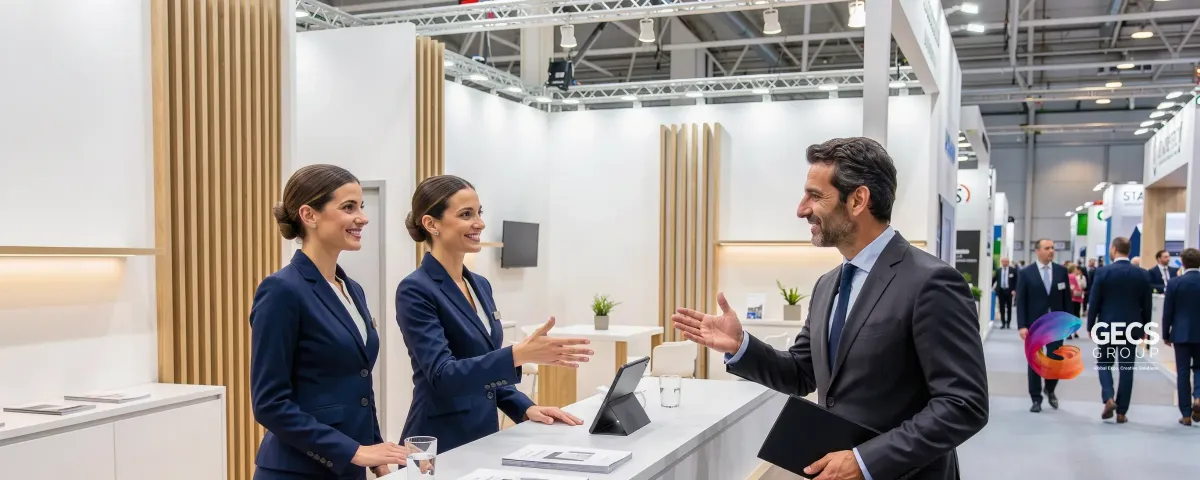
Hostesses and stewards for trade shows: what they do at the stand, how many you need, languages, briefing, uniforms and indicative daily costs.
At an exhibition stand, people matter as much as the structure. Hostesses and stewards welcome visitors, direct them to the right salesperson, collect contacts and keep the stand tidy, leaving the sales team time to negotiate. A good hostess makes the company look bigger and better organised.
In this guide we cover roles, how many you need, languages, briefing, uniforms, costs and how to fit them into the stand design. If this is your first experience, also read how to prepare for your first trade show.
In short: one hostess per 30–50 m² of stand is usually enough, with at least one speaking the languages of foreign visitors. A clear briefing on the company, products and contact collection procedure is essential. Indicative costs range from about €150 to €350 per person per day.
1. Roles at the show

| 👤 Role | 🧭 What they do | 🎯 When needed |
|---|---|---|
| 🙋Welcome hostess | Greets, directs, introduces the salesperson | Always, at the stand entrance |
| 🗣️Interpreter hostess | Translates and assists foreign visitors | International shows |
| 📇Promoter | Stops visitors in the aisle, hands out material | Launches, consumer products |
| 🍽️Catering hostess | Serves coffee and drinks, looks after the guest area | Stands with a lounge area |
| 🧑💼Coordinator | Manages shifts, briefings and surprises | Large stands or several days |
2. How many hostesses you need

As a guide, one hostess for small stands up to 30 m², two or three for stands of 50–100 m², more for large or double-deck stands. Shifts must be considered: a four-day show with long hours requires breaks and changeovers. Better one person too many than an unattended stand at peak time.
3. Languages and skills

At international shows at least one hostess must speak fluent English, and if visitors are expected from specific countries (Germany, France, Arab countries) it is worth having someone who speaks their language. Presence, punctuality, trade show experience and the ability to understand within seconds who the visitor is also count.
4. Briefing, uniforms and workstation

Before the show a briefing is needed: who the company is, the main products, who the salespeople are and their names, how to record contacts (tablet, forms, badge scanner). Uniforms should be coordinated with the brand colours. The stand needs a dedicated workstation: a reception desk with space for materials, a tablet and a small storeroom.
💬 Need hostesses and a ready stand for your next show? Tell us the dates, show and languages: we will propose stand and staff together. Ask for a proposal →
5. Collecting contacts and results

Hostesses' work is measured in the contacts collected and their quality. A simple procedure works best: name, company, interest, priority, who will call back. That way, once the show is over, the salesperson knows whom to call first. To measure the return, read our guide to trade show ROI.
6. Indicative costs

| 👤 Profile | 💶 Indicative daily cost | 🕘 Typical hours |
|---|---|---|
| 🙋Welcome hostess | €150–250 | 8 hours |
| 🗣️Interpreter hostess | €220–350 | 8 hours |
| 📇Promoter | €150–260 | 8 hours |
| 🧑💼Coordinator | €250–400 | 8–10 hours |
Travel, meals and accommodation, overtime and uniforms are added where needed. Prices and conditions vary by city and period.
Mistakes to avoid
- No briefing. The hostess can't answer and the visitor leaves.
- Too few people. At peak times the stand is left unattended.
- Hostesses without the right languages. Foreign visitors are lost.
- No workstation. Bags, materials and coats end up on view.
- Contacts on loose sheets. After the show nobody knows whom to call back.
Profiles and indicative rates
Support staff at a show are not all the same: different roles require different skills and have different costs. The figures below are indicative for shows in Italy, for a day of about eight hours, and vary by city, season and agency.
| 👥 Profile | 📋 Main tasks | 💶 Indicative daily rate |
|---|---|---|
| 🙋Welcome hostess or steward | Welcoming, handing out materials, managing flows | €150–220 |
| 🌍Hostess or steward with languages | Welcoming foreign visitors, first information | €180–280 |
| 🗣️Interpreter | Interpreting during business meetings | €350–600 |
| 🎯Promoter or demonstrator | Product demonstrations, tastings | €180–300 |
| 🧭Staff coordinator | Managing shifts, briefings, quality control | €250–400 |
For shows outside the city, travel, accommodation and meals are added, and sometimes the cost of uniforms. Agencies usually apply a minimum number of days or hours and a surcharge for last-minute bookings.
An example: staff for an 80 m² stand at an international show
A furniture company exhibits at a large international show in Milan with an 80 m² stand and expects many foreign visitors. It organises the staff as follows: two hostesses at the stand entrance, who welcome visitors, record contacts on a tablet and direct visitors to the right salespeople; a hostess speaking English and German who looks after waiting foreign visitors; a Chinese interpreter booked for two days when meetings with Asian distributors are planned; a barista running the hospitality area. Shifts cover the full opening hours with organised breaks.
The day before opening, the staff attend a two-hour briefing with the sales manager: company history, main products, indicative prices not to be disclosed, names of expected clients, contact collection procedure. The total cost for five days is roughly €6,000–9,000, excluding travel. At the end of the show the company has over 400 recorded contacts, sorted by country and interest, ready for follow-up.
The briefing: what staff need to know
A good briefing makes the difference between a hostess who just smiles and one who genuinely contributes to results. The minimum information to provide is: who the company is and what it produces, in a few sentences; the products on display and the three main messages to communicate; who the contacts on the stand are and for which topics; how to record contacts and what information to ask for; what to do with journalists, competitors and requests they can't handle; hours, breaks, dress code and rules of conduct. A summary sheet kept on the stand helps everyone remember everything during the show.
The welcome workstation
Staff work better if the stand is designed to accommodate them. A desk at the entrance, visible but not jutting too far into the aisle, with a surface for tablets and materials, a closed compartment for bags and catalogues and a socket to charge devices. A high stool for short breaks, a reserved area behind the stand to drink and rest. A cloakroom for guests' coats at winter shows. These are details that make the work more efficient and the welcome more professional. Find out more in our guide to reception desks and display counters.
How to choose the agency
Most companies turn to specialist agencies that select, train and manage staff. When evaluating them, ask how selection works, whether you can see profiles and references of the proposed staff, whether the agency provides an on-site coordinator, how it handles replacements in case of illness or absence, what type of contract it applies and whether staff are insured. A serious agency works with trained, motivated people, respects rules on work and breaks and guarantees attendance even on the busiest days. The lowest price often means poorly prepared staff and constant turnover.
For recurring shows it pays to work with the same agency and, if possible, the same people: they already know the company, the products and the clients, and the briefing becomes shorter and more effective.
Uniforms and image
Staff at a show represent the company and must be recognisable. The uniform can be simple, such as a shirt or polo with the logo and dark trousers, or more refined, coordinated with the stand colours. What matters most is that it is comfortable, because people are on their feet for many hours, suited to the season and the same for everyone. A badge with name and languages spoken helps visitors know whom to approach. Company staff should also wear coordinated clothing, so visitors can immediately tell who can give information.
Measuring the staff's contribution
Hostesses' work can be measured: number of visitors welcomed, contacts recorded, appointments set with salespeople, materials handed out, participants in tastings or demonstrations. With a digital contact collection system these figures are available every evening and make it possible to adjust the organisation immediately if something isn't working, for example by moving someone to the entrance at peak times. At the end of the show, together with commercial results, they help you see whether the number and type of staff were right. Find out more in our guide to trade show contacts and leads.
Behaviour at the stand: simple rules
- Stand up and face the aisle: someone sitting or on the phone looks unavailable.
- Don't block the entrance: two people standing in front of the stand discourage those who would like to come in.
- Ask open questions: “What are you looking for for your company?” works better than “Can I help you?”.
- Don't eat on the stand: breaks are taken out of visitors' sight.
- Record contacts straight away: note interests and next steps during or right after the conversation.
- Hand the visitor over to the right salesperson: without making them wait too long and introducing them by name.
These rules apply to hostesses as much as to company staff: the stand communicates through people more than through graphics.
Hostesses for events and conventions
The same staff also work at conventions, conferences, product launches and corporate dinners, with different tasks: guest registration, badge distribution, cloakroom, seating guests, handling the microphone during questions, assisting speakers. At events, punctuality and the ability to handle surprises — guests not on the list, programme changes — matter a lot. A coordinator who knows the running order and keeps in touch with the organisers is essential from as few as ten people. Also read our guide to conference and convention set-ups.
Summary
Welcome staff are the first point of contact between the visitor and the company. Choosing the right profiles, booking in advance, giving a full briefing, preparing a suitable workstation and measuring results turns hostesses from a mere presence into real sales support, able to increase contacts and appointments.
Frequently asked questions
Quick answers to the questions we hear most often
Can hostesses sell the products?
They can give initial information and collect contacts; the commercial negotiation remains the job of the company's staff, who know prices and conditions.
How far ahead should staff be booked?
For major shows at least six weeks before; for profiles with rare languages or interpreters even earlier, because demand is high on the same days.
How many hours can a hostess work at a show?
Usually an eight-hour day with breaks; for longer hours it is best to organise two shifts, so staff stay fresh and attentive until closing.
Can hostesses use a tablet for contacts?
Yes, and it is recommended: a digital form with privacy consent reduces errors and gives you contacts already sorted at the end of each day.
Are staff needed even for small stands?
For 9–16 m² stands two company people are often enough; a hostess helps above all at very busy shows or with many foreign visitors.
Can you get native-speaker hostesses?
Yes, many agencies have native-speaker staff for the most requested languages; for less common languages it is best to book well in advance.
How much does a trade show hostess cost?
Roughly €150–250 per day for welcome staff, up to €350 for profiles with languages.
How many hostesses are needed for a 50 m² stand?
Usually two, with shifts if the show lasts several days.
Do hostesses need to know the products?
A basic knowledge is enough: their job is to welcome visitors and direct them to the right salesperson.
Can you organise stand and hostesses together?
Yes, we build the turnkey stand and coordinate hostesses, catering and logistics.
Do you also work at shows abroad?
Yes, in Italy and throughout Europe.

Want stand and hostesses with a single point of contact?
We build turnkey exhibition stands and coordinate services such as hostesses, catering and logistics, in Italy and Europe.