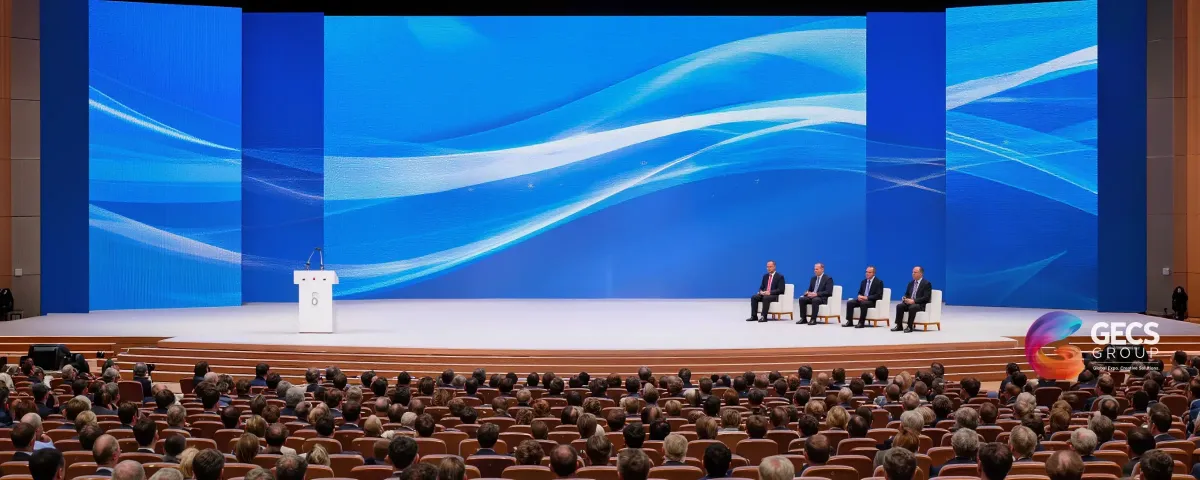
How to set up a congress or convention: stage and set design, LED wall and audio, plenary room, registration, sponsor area, timing and costs.
A congress or corporate convention brings together hundreds or thousands of people for one or more days: speakers, audience, sponsors, press. The set-up decides whether the event looks professional or improvised, whether people at the back of the room can hear well and whether sponsors are glad they invested.
In this guide we look at stage and set design, technical equipment, room, registration, exhibition area, timing and costs. For brand events, also read our guide to corporate event and product launch set-ups.
In short: start from the venue and the programme, design a stage that can be read from every seat, choose the room layout, take care of the welcome and give sponsors a visible, well-lit area. Build-up must be planned for the hours when the venue is free.
1. Venue and room layout

| 🎤 Layout | 🪑 When to use it | 📐 Capacity |
|---|---|---|
| 🏛️Theatre | Plenaries, keynotes | Maximum |
| 🎭Semicircle | Round tables, assemblies | Medium |
| 🏫Classroom | Courses, workshops with note-taking | Reduced |
| 🍽️Round tables (cabaret) | Conventions with gala dinner | Reduced |
2. Stage and set design

The stage must be high enough to be seen from the back rows (usually 40–80 cm), with a safe ramp or steps, a lectern, armchairs for panels and a backdrop with the event brand. The set can be in painted timber, in printed fabric on an aluminium frame or integrated with a large LED wall.
3. Technical: video, audio and lighting

LED walls or projectors for slides, repeater screens in large rooms, headset and handheld microphones, audio and video control, soft front lighting on speakers and streaming if the event is hybrid. A full rehearsal the day before prevents most surprises.
4. Registration and welcome

The first impression is made at the registration desk: well-lit counters, clear signage, badge printers, cloakroom and kiosks with programme and maps. Read our guide to reception desks and display counters.
💬 Organising a congress or convention? Send us the venue floor plan and the programme: we will propose stage, set design and sponsor area. Ask for a proposal →
5. Exhibition and sponsor area

Sponsors pay to be seen: their stands belong in the foyer and in the coffee-break areas, where the whole audience passes. Identical 2×2 or 3×2 modular stands with desk, graphics and lighting can be built in one night; main sponsors can have a custom stand.
6. Timing and costs

| 🧩 Item | 💶 Indicative cost | ⏱️ Build-up time |
|---|---|---|
| 🎬Stage and set design (300–500 seat room) | €8,000–30,000 | 1 night – 1 day |
| 📺LED wall, audio and lighting | €6,000–35,000 | 1 day |
| 🛎️Registration desk and signage | €2,000–10,000 | a few hours |
| 🏷️Modular sponsor stand | €1,200–3,500 each | 1 night |
Mistakes to avoid
- Stage too low. The speaker can't be seen from the back rows.
- Screen too small. The slides can't be read.
- Sponsors in a corner. Nobody visits them and they don't come back.
- Slow registration. Queues and delays at opening.
- Build-up not coordinated with the venue. Hours and loads not respected.
Room layouts and capacity
The seating layout greatly changes capacity and the type of interaction between speakers and audience. Indicative figures help choose the right room and design the set-up.
| 🪑 Layout | 📏 Space per person | 🎯 Suitable for |
|---|---|---|
| 🎭Theatre | 0.8–1 m² | Plenary sessions, presentations, keynotes |
| 📚Classroom (with tables) | 1.5–2 m² | Courses, sessions with notes and laptops |
| 🍽️Cabaret (half-moon round tables) | 1.8–2.2 m² | Workshops, group work, interactive sessions |
| 🥂Banquet (round tables) | 1.5–2 m² | Gala dinners, award ceremonies |
| 🧲U-shape | 2–3 m² | Small meetings, committees, round tables |
Stage, control desk, aisles, escape routes and technical positions must be added to these spaces. A 500 m² room can hold about 400–450 people theatre-style, but only 200–250 in classroom layout. Always check the room's maximum authorised capacity, which depends on the emergency exits.
An example: a two-day medical congress for 400 participants
A scientific society holds its annual congress in a conference centre in northern Italy: 400 participants, a plenary room, two rooms for parallel sessions, an exhibition area with 20 sponsor company stands, a poster area and a catering zone. The plenary set-up includes a 10×4 metre stage with a speakers' table and lectern, a central LED wall and two side screens, and a video control room that films the speakers and streams the sessions for online registrants. The parallel rooms have projectors, microphones and a simple coordinated set.
The exhibition area is organised with 9 and 12 m² modular stands for sponsors, clear signage and routes that lead participants from the entrance to the catering past the stands. Build-up takes two days, dismantling one night. The cost of the set-up, covering stage, technical equipment, stands, signage and furniture, is roughly between €70,000 and €120,000, excluding venue, catering and secretariat services.
The sponsors' exhibition area
For many congresses sponsors are a key source of funding, and the quality of the exhibition area affects their satisfaction. Stands must be visible and well placed along the main routes, especially near the catering and coffee breaks, when participants have time to stop. Offering sponsors turnkey stand packages, with structure, graphics, lighting, sockets and basic furniture, simplifies their participation and guarantees a uniform look for the area. Main sponsors can have larger, customised spaces, dedicated sessions or logo visibility on stage and in materials. Find out more in our guide to stand hire.
Simultaneous interpretation and international congresses
International congresses often need simultaneous interpretation. Classic solutions include soundproof booths for interpreters, with a direct view of the stage, and receivers with headphones for participants. The booths go at the back or side of the room, with adequate space, power and cabling. Today there are also remote interpretation systems, with interpreters connected online and audio sent to participants' smartphones, useful for hybrid events or less common languages. In both cases the quality of the source audio — microphones and control desk — is decisive for good interpretation.
The congress set-up budget
| Item | Indicative share | Notes |
|---|---|---|
| ▸Audio, video and lighting | 30–40% | Control desk, LED wall, projectors, microphones, streaming |
| ▸Stage and set design | 15–25% | Platforms, backdrop, lectern, speakers' table |
| ▸Exhibition area | 15–25% | Sponsor stands, carpet, sockets, graphics |
| ▸Signage and graphics | 5–10% | Kiosks, signs, photo backdrop, badges |
| ▸Welcome and furniture | 10–15% | Registration desk, cloakroom, lounge |
| ▸Build-up and dismantling | 10–15% | Crews, technicians, any night work |
Many conference centres include part of the technical equipment in the room price, while in hotels and non-specialist venues almost all of it must be brought in. It is worth clarifying immediately with the venue what is available, to avoid duplicates or gaps.
Welcome, registration and signage
A congress's first impression forms at the registration desk. You need a large space near the entrance, with modular desks divided by letter or participant type, badge printers, sockets and a stable connection. Queues form at arrival times: it is worth providing several stations, possibly with self check-in kiosks for those already registered online. Signage must guide participants from the entrances to the rooms, cloakroom, toilets, exhibition area and catering, with signs readable from a distance and an up-to-date session programme, on paper or on digital screens. A well-lit backdrop with the congress and sponsor logos becomes the spot for official photos and selfies.
Safety and accessibility
A congress brings hundreds of people together indoors: escape routes must stay clear and signposted, set-ups must not cover extinguishers, hydrants and exits, and materials must have the required fire reaction class. The stage and structures must be certified, and cables protected to prevent tripping. For accessibility you need barrier-free routes, reserved places in the room for wheelchair users, a ramp to the stage when a speaker needs one and hearing assistance systems. An experienced set-up company prepares the technical documentation the venue requires and works with the safety manager. Also read our guide to safety during build-up.
The stage: sizes and practical rules
The stage must be in proportion to the room and the type of session. For a plenary of 300–500 people, stages 8–12 metres wide and 4–5 deep, 40–60 cm high, are often used, so that speakers are visible from the back rows too. Platforms must be stable, with marked edges and steps with a handrail; if possible, an accessibility ramp. The speakers' table should be placed so as not to block the screens; the lectern needs a microphone, its own light and a confidence monitor showing the slides to the speaker. The background, with LED wall or graphic backdrop, must stay readable in video shots, with no text cut off by the framing.
Hybrid events: what changes in the set-up
When the congress is also followed online, the set-up must think about two audiences. For remote viewers, the quality of filming and audio matters: even lighting on speakers without harsh shadows, clean backgrounds, quality microphones and a control room that alternates shots of speakers and slides. You also need space for the streaming control, with workstations and a dedicated, redundant connection. For questions from the online audience, a moderator collects them and reads them in the room. A small separate set with a branded background also allows interviews with speakers to be recorded during breaks, useful for later communication.
Build-up times
For a medium-sized congress, build-up usually takes one or two days: the first for stage, structures, technical equipment and exhibition area, the second for graphics, audio and video tests and rehearsals with speakers. In very busy venues timing is tighter and work continues at night; dismantling, by contrast, is often concentrated in the closing night itself. Precise planning, with loading and unloading times agreed with the venue, is essential to meet the deadlines.
Summary
Setting up a congress means choosing the right room layout, building a clear stage and set, guaranteeing flawless audio and video, and organising registration, signage and a sponsor exhibition area, while respecting safety and accessibility. With a single partner for set-up and technical equipment, organisers and speakers can focus on content.
Frequently asked questions
Quick answers to the questions we hear most often
Can the congress be streamed?
Yes, with video control, cameras and a dedicated connection; for scientific congresses access is often restricted to registrants via a platform.
Do all sponsor stands have to be identical?
Often a standard model is offered to everyone for a tidy area, while main sponsors may have larger customised stands.
Is a poster area needed for scientific congresses?
Yes, poster areas are common at medical and scientific congresses: numbered, well-lit panels placed along break routes.
Who supplies the microphones and control desk?
In conference centres often the venue; in hotels and non-equipped venues the technical supplier, who brings the system, control desk and technicians.
Can the set be reused for the next edition?
Yes, if designed in modules: just update graphics and colours to give the new congress a different identity at limited cost.
How much does it cost to set up a congress?
For a 300–500 seat room with a sponsor area, roughly from €20,000–30,000, depending on technical equipment and set design.
How long does build-up take?
Usually one night or one day before the event; dismantling takes place on the evening of closing.
Do you also build sponsor stands?
Yes, identical modular stands for everyone or custom stands for main sponsors.
Do you work in hotels and conference centres?
Yes, we respect each venue's regulations, loading times and required materials.
Do you work throughout Italy and Europe?
Yes, we produce in Italy and build throughout Italy and Europe.

Need a partner for your congress?
We design and build in Italy stages, set designs, registration desks and sponsor stands, with overnight build-up and fast dismantling throughout Italy and Europe.