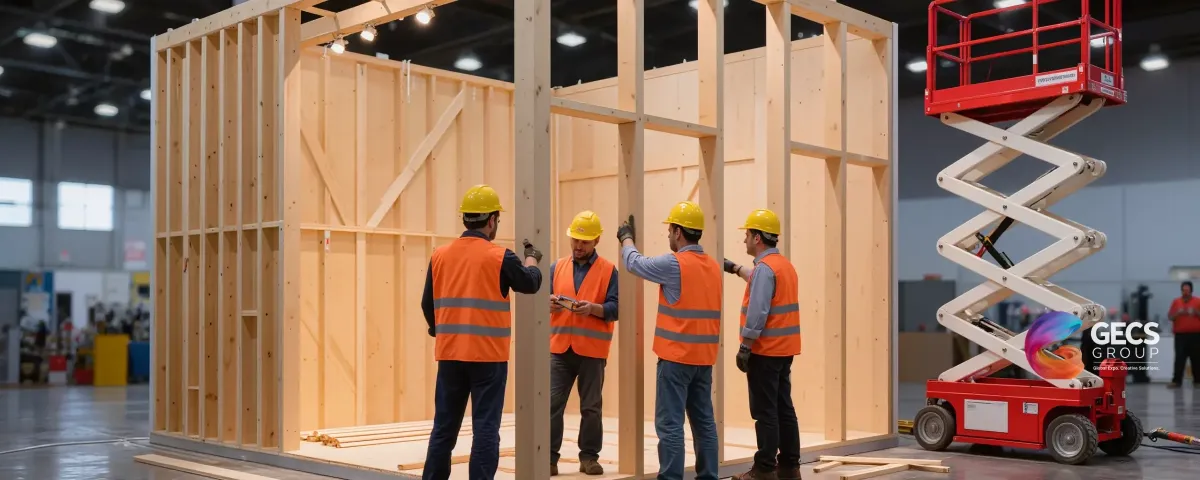
How safety is organised during stand build-up and dismantling: roles, risk documents, safety plans, training, PPE, work at height and vehicles in the hall.
Building a stand is, to all intents and purposes, a temporary construction site: within a few days, in the same hall, hundreds of people from different companies work with forklifts, platforms, ladders, power tools and suspended loads. The risks are real: falls from height, collisions with vehicles, crushing during unloading, cuts, electric shocks. That is why shows apply precise safety rules and ask every company entering the hall for documents.
In this guide we explain in practical terms who is responsible for what, what the interference risk document and the site safety plan are, which protective equipment is needed, how to work at height and how to manage vehicles. In Italy the reference is the Consolidated Act on safety (Legislative Decree 81/08) plus each exhibition centre’s specific rules: here we give a general overview, which does not replace advice from a safety professional.
In short: the organiser coordinates safety across the venue, the exhibitor must choose suitable companies and share risk information with them, and the contractor prepares its own operational plan, trains its workers and provides PPE. Work at height is done only with suitable platforms and mobile towers, with harnesses where required. Vehicles move at walking pace, with a colleague on the ground guiding them.
1. Who does what: organiser, exhibitor and contractor

At a trade show there are three levels of safety responsibility. The organiser or venue manages the site: it sets rules, hours, vehicle routes and rigging points, and coordinates the simultaneous presence of many companies. It provides a document with the venue’s risks and the rules to follow, and its own staff check compliance during build-up.
The exhibitor is the client for the work on its own stand. Even if it does not build anything with its own hands, it must check that the companies chosen are suitable, give them information on the risks and coordinate them if there is more than one (for example the stand builder, the electrician and the LED wall supplier). Finally, the stand contractor is the employer of the crews: it is responsible for training its staff, for the equipment and for the way the work is carried out.
| 👤 Party | 📋 Main responsibilities | 📄 Typical documents |
|---|---|---|
| 🏛️Organiser | Venue rules, overall coordination | Regulations, venue risk information |
| 🏢Exhibitor | Choosing suitable companies, coordination on the stand | Interference risk document or coordination plan |
| 🛠️Stand contractor | Crews, working methods, equipment | Site safety plan, training certificates, suitability |
| 👷Worker | Following procedures, using PPE | Badge, personal certificates |
2. The interference risk document and coordinating companies

In Italy the DUVRI (single document assessing interference risks) is needed when several companies work in the same place for one client: it describes the risks arising from working together and the measures to reduce them. At a show, interference is everywhere: the electrician working under the platform while the builders raise the walls, the LED wall supplier arriving with a platform while the carpet is being laid.
In trade show practice, coordination is based on several documents: the venue risk information supplied by the organiser, the coordination document prepared by the exhibitor or the main contractor, and the plans of the individual companies. What matters is that everyone knows who is working, where, when and with what equipment, and that there is one reference person on the stand coordinating the activities.
A practical tip: entrusting the coordination of all work on the stand to a single contractor makes things much simpler. One crew leader organises the sequence, avoids dangerous overlaps and liaises with the show’s staff.
3. Safety plan, suitability and crew training

The POS (operational safety plan) is the document in which the stand builder describes how it works on that site: who the workers are, which equipment they use, which risks arise in each phase (unloading, structure build-up, work at height, electrics, dismantling) and which measures are taken. Many shows request it before entry into the hall, together with documents proving the company’s technical and professional suitability.
Crew training includes general and specific safety training, plus dedicated courses for mobile elevating work platforms, forklifts, work at height with harnesses, mobile tower assembly and, for electricians, electrical work. Certificates must be valid and available: in case of inspection, the crew leader must be able to show them.
Our crews have worked for years at Italian and international shows and keep their documentation constantly up to date. This is also a guarantee for the exhibitor, who as the client is obliged to check the suitability of the company it hires.
4. Personal protective equipment

During build-up and dismantling the hall is a construction site, and everyone working there must wear the required PPE. The minimum rules apply to all: safety shoes and high-visibility clothing are almost always mandatory; helmets are needed when working under moving structures or suspended loads; gloves, goggles and hearing protection are used depending on the task.
| 🦺 PPE | 🎯 When it is needed | 📌 Remember |
|---|---|---|
| ⛑️Helmet | Under suspended loads and platforms | With chin strap when working at height |
| 🦺High-visibility vest | In the hall during build-up | Often mandatory for everyone |
| 🧤Gloves | Handling, cutting, assembly | Different types for cuts and grip |
| 👟Safety shoes | Always on site | Toe cap and puncture-resistant sole |
| 🥽Safety glasses | Cutting, drilling, using adhesives | Also for those working nearby |
| 🪢Harness | Elevating platforms and work at height | Clipped to the designated points |
The exhibitor and its staff must also follow these rules if they enter the hall during build-up to check the stand or bring products. It is worth having shoes and vests available for these visits.
5. Work at height: platforms and mobile towers

Falls from height are the most serious risk in stand building. Work at height is needed to install trusses, tall graphics, ceilings, signs and lights. Ladders should only be used for short, low-level jobs; everything else requires mobile elevating work platforms (scissor or boom lifts) or correctly assembled mobile towers, with guardrails and locked wheels.
On platforms, work is done with a harness clipped to the points specified by the manufacturer, always with a colleague on the ground cordoning off the area below. Nobody should pass under the basket while work is going on. Platforms are only used on flat, clear floors: before moving them the route is checked, because at a show cables, platforms and materials are everywhere.
Structures hung from the hall ceiling are a separate case: they are usually installed only by the venue’s technical service or authorised companies, with specific equipment and procedures. We covered this in our guide to rigging for stands.
6. Vehicles, unloading and loading areas

During build-up days, trucks, vans and forklifts move in crowded spaces. The basic rules are simple but must be followed without exception: vehicles enter at the set times and in the designated areas, move at walking pace, forklifts are driven only by trained staff and, when visibility is reduced, a colleague on the ground guides the manoeuvre. The load must be stable and must not block the driver’s view.
Unloading must be organised in advance: knowing which crates arrive first, where to put them and how much space is needed. A truck that stays parked for a long time in front of the hall also blocks others and creates dangerous situations. For the organisational side, see our guide to stand transport and logistics.
Dismantling is often more dangerous than build-up: everyone is in a hurry, aisles fill with material and vehicles come in while neighbouring stands are still being taken down. Keeping order, separating waste and leaving no material in the aisles greatly reduces the risks.
💬 Need to prepare the safety documents for your show and don’t know where to start? We can help: our crews work with up-to-date safety plans, training and PPE. Ask for information →
The role of the crew leader
Every well-organised stand has a crew leader who knows the design, the build sequence and the show’s rules. This is the person who holds the start-of-work briefing with the crew, explains the day’s risks, checks that everyone has PPE, coordinates the other companies working on the stand and talks to the show’s staff when inspections arrive.
The crew leader also decides when to stop. If a suitable platform is missing, if a floor is not level, if a structure does not match the design, the right choice is to suspend that work and find a solution, not to improvise to gain an hour. At a show time is tight, but an accident halts everything for much longer than any delay.
For the exhibitor, the crew leader is the single point of contact: one phone number for every question, from product delivery to the end time of work. On our build-ups it is always someone who has worked with us for years and has already handled similar stands, in Italy and abroad.
Safety continues once the show is open
When visitors arrive, the construction site is over but responsibility for the stand is not. The stand must remain safe for the public throughout the event: stable walls, fixed shelves, protected corners, hidden cables, floors without dangerous level changes. A platform a few centimetres high should be marked with a bevelled edge or a ramp, especially if the stand must also be accessible to wheelchair users.
Every day, before opening, it is worth doing a check round: spotlights firmly fixed, graphics taut, nothing resting on tall structures, extinguishers and exits clear, sockets covered. During the day staff should avoid piling boxes in walkways and keep the storeroom tidy, as it often becomes a store of flammable materials such as paper, cardboard and packaging.
Pay attention to demonstrations too: working machinery, hot products, sharp tools or lasers must be protected with barriers and explained to visitors. If the stand cooks or serves drinks, you need easy-to-clean surfaces, anti-slip mats behind the counter and clear waste management. Finally, every evening the stand must be closed safely: systems off except night circuits, valuable products in locked cabinets or in the storeroom.
For dismantling, everything said for build-up applies, with extra attention to haste. We cover this in our guide to stand build-up and dismantling.
Mistakes to avoid
- Documents prepared at the last minute. Without a safety plan and certificates the crew may not be allowed into the hall.
- Ladders instead of platforms. Long or high jobs need suitable equipment.
- Working under suspended loads. The area beneath anyone working at height must always be cordoned off.
- Uncoordinated companies. Electricians, builders and suppliers working together without direction.
- Cluttered aisles. Material and waste in the aisles block vehicles and escape routes.
- Exhibitor staff without protection. Even those visiting the site must follow the rules.
Trade show safety checklist
- Venue safety rules read and shared with the contractor.
- Coordination document between the companies working on the stand.
- Crew safety plans and training certificates ready and available.
- PPE for everyone, including exhibitor staff visiting the site.
- Platforms and mobile towers booked for work at height.
- Unloading plan and vehicle entry times.
- A crew leader present and reachable throughout the build-up.
Frequently asked questions
Quick answers to the questions we hear most often
Who must prepare the interference risk document for the stand?
The client for the work, i.e. the exhibitor, with the support of the stand contractor. In trade show practice it is combined with the risk information provided by the organiser.
Is the safety plan always mandatory?
Many shows require it from all companies building stands; in any case it is the right way to describe how work is done safely.
Can I build the stand with my own employees?
Yes, but your employees must also be trained, equipped with PPE and follow the show’s rules, like any other company.
Who can use platforms and forklifts?
Only staff with specific training and a valid certificate for that type of equipment.
Do stand staff need to wear PPE?
During build-up and dismantling, yes, if they enter the hall. While the show is open to the public, no.
Do your crews also work abroad?
Yes, with the documentation required by exhibition centres in Europe, the United Kingdom and the Middle East.

Want a stand built on time and without risk for anyone?
GECS Group build-up crews work with complete safety documents, up-to-date training, certified equipment and a crew leader always on site, in Italy and abroad.