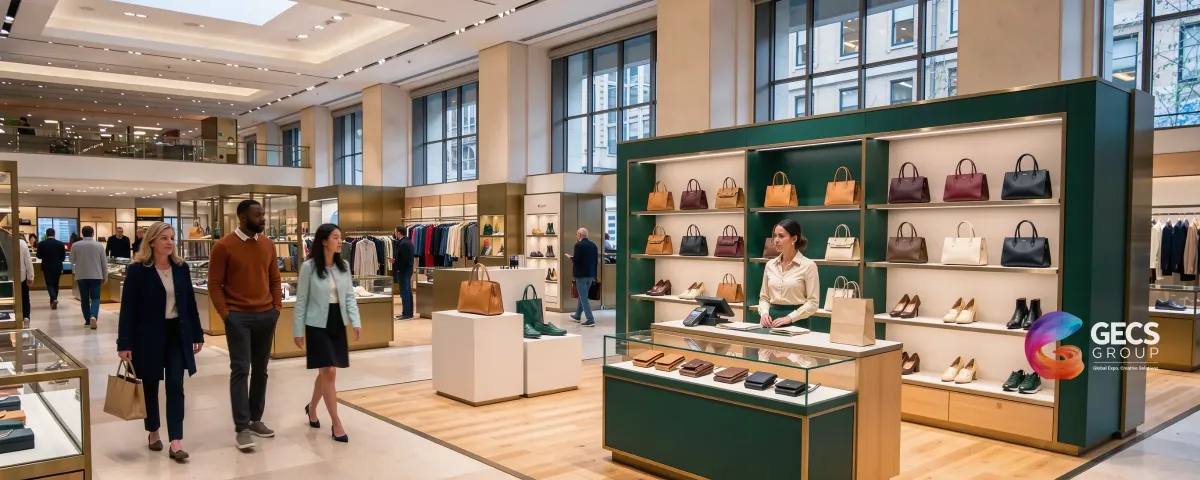
Shop-in-shops and brand corners: differences, brand guidelines, design, production and installation, rollout across several stores and indicative costs.
A shop-in-shop is a brand store inside another store: a department store, a shopping centre, a multi-brand shop. A corner is its smaller version, often one or two wall sides with dedicated furniture. In both cases the goal is the same: make the brand recognisable at a glance and sell better, even in a space that isn't yours.
In this guide we look at the differences, the rules of the brand and of the host store, design, production, installation, rollout and costs. If you are looking for a stand-alone space in a mall, read our guide to islands and kiosks for shopping centres instead.
In short: a corner is a branded area of a few square metres, a shop-in-shop is a small complete store inside another one. They are designed following the brand guidelines and the host store's regulations, produced in modules and installed in a few hours, often at night.
1. Corner or shop-in-shop: the differences

| 🏷️ Format | 📐 Typical area | 🎯 When to choose it |
|---|---|---|
| 🧱Wall corner | 3–10 m² | Product lines, cosmetics, accessories |
| 🏬Open shop-in-shop | 15–60 m² | Fashion, electronics and home brands |
| 🗂️Closed shop-in-shop | 30–120 m² | Luxury, full brand experience |
| 🛍️Brand gondola or island | 2–8 m² | Launches, promotions, small spaces |
2. Brand guidelines

Brands with several points of sale have a manual specifying colours, materials, logo, graphics, lighting and product layout. The design starts from there and adapts it to the real dimensions and constraints of the space. A good supplier immediately flags what cannot be built or costs too much and proposes equivalent alternatives, without betraying the brand image.
3. The host store's rules

Department stores and shopping centres have precise technical regulations: maximum heights, certified fire-retardant materials, compliant electrical systems, installation hours, goods access. Installation is often only allowed at night or outside opening hours. It is worth asking for the regulations before designing, as with pop-up store fit-outs.
4. Design and production

The design includes the floor plan, renderings and construction drawings of every element: fitted walls, counter, display cases, totems, signage, lighting. Modular production allows easy transport, fast installation and the ability to replicate the same corner in other stores with consistent quality. For the design side, read our guide to retail store design.
💬 Need a corner or a shop-in-shop? Send us your brand guidelines and dimensions: we will propose a design and a quote. Ask for a proposal →
5. Installation and rollout across several stores

A corner is usually installed in one night, a shop-in-shop in 1–3 nights. When the brand opens in several cities or countries, it is called a rollout: same furniture, same instructions, coordinated crews. Our crews install in Italy and throughout Europe, with packaging designed for transport and a final photo check for the brand.
6. Indicative costs

| 📐 Project | 💶 Indicative cost | ⏱️ Timing |
|---|---|---|
| 🧩Wall corner 3–10 m² | €5,000–20,000 | 3–5 weeks |
| 🏬Open shop-in-shop 15–60 m² | €20,000–80,000 | 5–8 weeks |
| 🏛️Luxury shop-in-shop | from €1,250/m² | 8–12 weeks |
| 🔁Rollout replicas | −10–25% on the first | Depending on quantity |
Mistakes to avoid
- Ignoring the host store's regulations. You risk having to redo everything.
- Copying the manual without adapting it. Real dimensions and flows are different.
- Uncertified materials. The department store can block the installation.
- No storage in the corner. Staff walk away for every size.
- Different suppliers in each city. The brand loses consistency.
The most common formats
Between a simple brand display and a store within a store there are several intermediate formats. Knowing them helps you choose the one best suited to your goals and budget.
| 🏷️ Format | 📐 Typical area | 🧩 Elements | 🎯 Suited to |
|---|---|---|---|
| 🖼️Brand display | 1–2 m² | One unit with logo and products | Product launches, small retailers |
| 🧱Brand wall | 3–6 linear metres | Fitted wall with graphics and lighting | Perfumeries, opticians, electronics |
| 🏬Corner | 6–20 m² | Wall, counter, displays, dedicated flooring | Department stores, multi-brand stores |
| 🛍️Shop-in-shop | 20–100 m² | Defined space with its own till and staff | Fashion, luxury and design brands |
| 🏛️Concession or in-store flagship | over 100 m² | Complete store inside a department store | International brands |
The bigger the format, the greater the brand's autonomy, the investment and the obligations towards the host store, which usually sets precise rules on materials, heights, lighting and working hours.
An example: a cosmetics corner in 25 perfumeries
An Italian natural cosmetics brand wants to enter 25 perfumeries of a chain in Italy and Switzerland. The design includes a modular corner made up of a backlit display wall with acrylic shelves, a testing counter with a mirror and a solid-surface top, and a double-sided gondola for travel sizes. The modules are 60 and 90 cm, so the corner fits spaces from 1.8 to 4.5 linear metres. Before series production a prototype is built and installed in a pilot store to check dimensions, installation and effect.
After corrections, the 25 corners are produced in six weeks and installed in four weeks by two crews, at night or on closing days. Each corner is photographed at the end of installation and the documentation is sent to the brand. The cost per corner, produced in series, is roughly €6,000–11,000 depending on length, installation included. The brand gets an identical image in every point of sale and can monitor installation store by store.
The rollout: how to manage dozens of installations
When a corner has to be replicated in many stores, the real challenge is organisation. You need a survey of each point of sale, even one done by store staff with a guided form and photos; an adapted design for each, with the most suitable combination of modules; a schedule of deliveries and installations agreed with the stores; a complete installation kit for each site, with instructions and spare parts; and a final report with photos and notes. A supplier used to rollouts has the tools and procedures to manage all this and a single contact coordinating the calendar.
It is also worth keeping a small stock of spare parts, such as shelves, lamps, graphics and feet, for later interventions. In the months after opening some pieces get damaged or lost, and having them available immediately prevents the corner from staying incomplete for weeks.
Brand guidelines and approvals
Structured brands have a manual setting out materials, colours, logos, lighting and product layout in their spaces. The fit-out company must follow it precisely and, if the manual has no solution for a particular space, propose adaptations for approval. At the same time the host store has its own rules: maximum furniture height, permitted materials, distance from other brands, neutral colours on adjoining sides, installation hours. The design must reconcile both and obtain approval from both parties before production, to avoid changes along the way.
Shop-in-shop at trade shows
The same concept also applies to collective stands at trade shows, where several brands or companies of a consortium share a single space. Each brand has its own recognisable corner, with coordinated elements and a common image for the whole. It is a solution that keeps costs down and makes a strong impression, typical of regional collectives and national pavilions. Also read our guide to the right stand for every sector.
How to measure a corner's performance
A corner is an investment and should be judged by the numbers. The main data are the brand's sales in the store before and after installation, sales per linear or square metre compared with other brands, the turnover of the products on display and, where possible, the number of customers who stop and try the products. Comparing stores with and without a corner, or corners with different configurations, helps you understand which solutions work best. With this data the brand can decide where to invest in larger corners, where a wall is enough and where it is worth renewing the fit-out.
Materials for corners that last
A corner works every day in a crowded environment: it is touched, bumped by trolleys and bags, and cleaned often by store staff. That is why materials must be sturdy and easy to maintain: high-pressure laminates, hard-wearing lacquers, protected edges, tempered glass or thick acrylic shelves, LED lighting with accessible drivers. Graphics must also be easy to replace, because they change with campaigns and seasons: tension fabrics, magnetic panels or snap frames let store staff update them in minutes, without calling an installation crew.
The most frequent mistakes
- Designing without seeing the real space: pillars, sockets, emergency exits and store lighting change everything.
- Ignoring the host store's rules: a corner that is too tall or uses colours that are not allowed has to be modified.
- No storage: without a small space for stock, the corner empties out and looks untidy.
- Fixed graphics: if changing them requires a technician, the corner stays with old campaigns for months.
- No maintenance plan: lights that are off and missing shelves damage the brand image.
The corner as a training tool
A good corner also helps the host store's staff, who often sell dozens of brands and cannot know them all in depth. Clear product cards, small screens with demonstration videos, a well-organised testing counter and a logical product layout make it easier to advise customers. Some brands back the corner with training days and dedicated materials for sales assistants. That way the corner is not just a display, but a place where the brand is told well even when its own staff are not there.
Summary
Corners and shop-in-shops let a brand be recognisable inside other people's stores, with a smaller investment than a store of its own. Good results require a suitable format, modules that adapt to different spaces, respect for brand and store rules, a well-organised rollout and materials that are easy to maintain and update.
Frequently asked questions
Quick answers to the questions we hear most often
Who pays for the corner: the brand or the store?
Usually the brand, which remains its owner; in some agreements the cost is shared or offset by commercial terms. This should be clarified in the contract.
Can the corner have its own till?
Shop-in-shops yes, with the brand's own staff; smaller corners usually use the host store's tills.
How long does a corner last before being renewed?
Usually three to five years for the structure; graphics and small elements are updated more often, with each campaign or season.
Can the modules be reused in another store?
Yes, if the corner is modular: the modules are dismantled and recombined in a new space, at a much lower cost than a new corner.
Is an approved design needed for each store?
For standard corners, approval of the model is often enough; for special spaces or larger shop-in-shops, the host store asks for a specific design with floor plan and elevations.
Can a corner be installed without closing the store?
Yes, installation is usually done before opening, in the evening or on closing days, in a few hours for smaller corners.
How much does a corner in a department store cost?
Roughly from €5,000 for a small wall corner up to €20,000 or more for more elaborate corners.
How long does installation take?
Usually one night for a corner, one to three nights for a shop-in-shop.
Do you work with brand guidelines?
Yes, we start from the brand manual and adapt it to the real space.
Can you replicate the same corner in several stores?
Yes, we produce in series and coordinate installation in several cities and countries.
Do you also work abroad?
Yes, we produce in Italy and install throughout Europe and beyond. For luxury stores, also read our guide to boutique fit-outs.

Want a turnkey corner or shop-in-shop?
We design, produce in Italy and install corners and shop-in-shops for brands, including across several stores and countries.