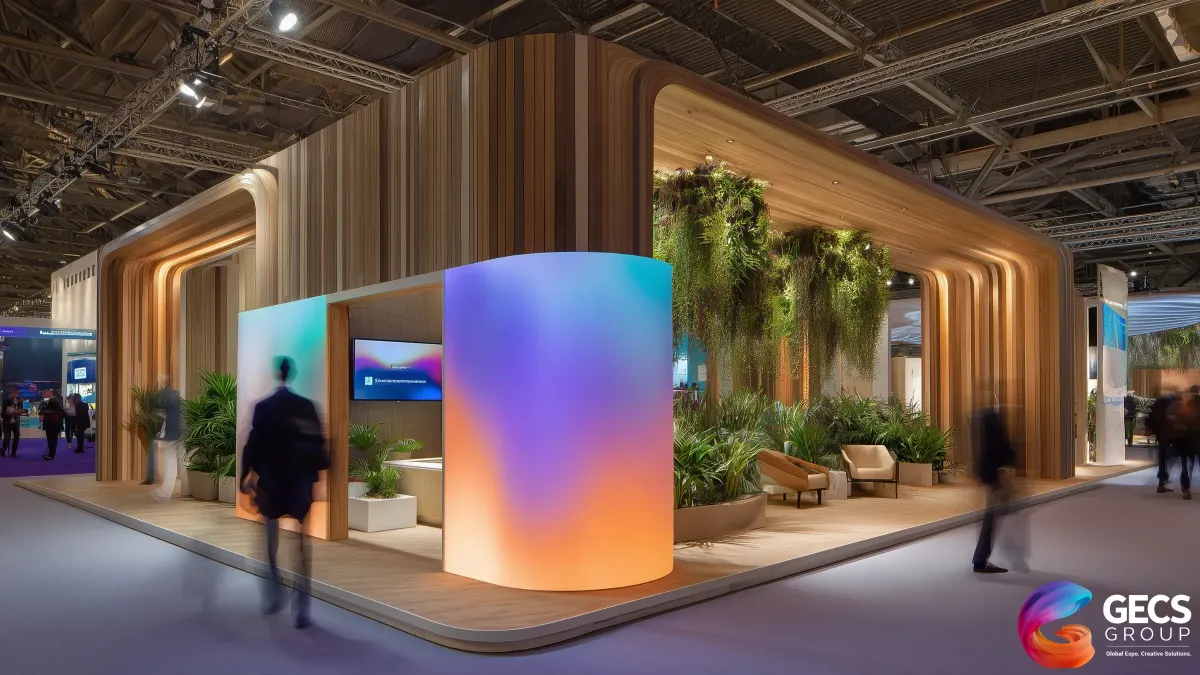
Reusable stands, natural materials, built-in lighting, screens as architecture, useful interactivity and private meeting rooms: the 10 trends for 2027 and how to choose them by goal and floor space.
An exhibition stand is designed months before the show, yet visitors judge it in a few seconds. That is why it pays to know where design is heading: not to chase fashion, but to understand which choices bring more visitors, more useful conversations and less waste. The exhibition stand design trends for 2027 all point the same way: stands that are lighter, warmer, high-tech only where it helps, and built to last longer than one show.
This guide covers the 10 trends that really matter, with a practical note on each: who it suits, how much it weighs on the budget and which mistakes to avoid. If you are starting from scratch, read our guide to exhibition stand design first.
In short: in 2027 the winners are reusable stands with natural materials and lighting built into the walls; screens become part of the architecture; interactivity only makes sense when it explains the product; private meeting rooms, real greenery and bold colours are on the rise. You do not need all ten trends: two or three are enough, chosen according to the goal of the show.
The 10 trends for 2027 at a glance
| 📌 Trend | 🔄 What changes | 💶 Budget impact |
|---|---|---|
| ♻️Reusable stands | The structure lasts several shows, only the graphics change | Higher at first, lower from the second show |
| 🌿Natural materials | Wood, fabric and cork instead of glossy laminates | Medium |
| 💡Built-in lighting | LEDs inside walls and counters, not just spotlights | Medium |
| 🖥️Screens as architecture | Curved LED walls, transparent displays, LED posters | Medium to high, best rented |
| 👆Useful interactivity | Touch tables, configurators, augmented reality | Medium |
| 🤖AI and lead capture | Contacts recorded digitally, tailored content | Low to medium |
| 🧭Open, zoned layouts | Fewer walls, more entrances and routes | Low |
| 🤝Private meeting rooms | A quiet space to negotiate | Medium |
| 🪴Greenery and biophilia | Real plants, moss walls, wood | Low to medium |
| 🎨Bold colour | One dominant colour and one message | Low |
1. Reusable and modular stands

The most solid trend is also the most practical: building a stand that does not end up in a skip after four days. Aluminium or timber structures are designed to be dismantled, packed into their own cases and rebuilt at another show, even on a different footprint. The fabric graphics and a few accent pieces change; everything else stays.
The benefit is not only environmental. If you exhibit three or four times a year, the structure pays for itself from the second show and build-up gets faster. The key is to decide early: a stand is born reusable on the designer's desk, it does not become reusable later. For figures, see how much an exhibition stand costs; if you exhibit once a year, consider renting a stand.
2. Natural materials and matt surfaces

After years of glossy laminates and white surfaces, stands are moving closer to interior architecture: slatted wood, fabrics, cork, recycled honeycomb cardboard panels and matt finishes that are pleasant to touch. In a hall full of shiny surfaces, a warm, tactile stand stands out and invites people to stop.
Be careful with green claims, though: organisers and clients increasingly ask for evidence, not adjectives. For each material it is worth having the data sheet, the fire-reaction certificate required by the venue and, for timber, certified origin. Single-use carpet is also giving way to reusable flooring.
3. Lighting built into the architecture

Spotlights on a truss are not going away, but on their own they are no longer enough. Light moves into the walls: LED profiles recessed into edges, counters that seem to float thanks to a line of light at the base, and large backlit fabric walls that act as both signage and light source. The result is a stand that reads clearly from a distance and feels restful up close, without glare.
The practical rule is to work on three levels: soft general light, accent light on the products, and contour light that draws the outline of the stand. Colour temperature must be consistent: warm for fashion, food and furniture, neutral for technology and engineering. More in our guide to LED walls, lighting and audio for stands.
4. Screens that become architecture

The screen hung on a wall is giving way to digital surfaces integrated into the structure: curved LED walls that follow the shape of the stand, slim LED columns (so-called LED posters) and transparent displays, behind which the real product stays visible while data and animations run across the glass. It works well for design objects, machines and technical components.
Two warnings. First: a screen without content made for that format is just a cost, so the video must be produced together with the stand, not the week before. Second: renting is almost always the better option, because this technology ages quickly.
5. Useful interactivity, not a show

Touch tables, product configurators, augmented reality to show a machine that would never fit in the hall: interactivity is growing, but with a new test. The question is no longer "what will amaze people?" but "what helps a visitor understand the product in two minutes?".
Before approving an interactive installation, check four things: how long the experience lasts, how many people it can serve in an hour, who on the team looks after it and what happens if the connection drops. A simple configurator that always works is worth more than a headset lying flat on the counter.
6. Artificial intelligence and lead capture

Artificial intelligence enters the stand mostly behind the scenes. At the design stage it speeds up concepts and variants; at the show it helps display different content depending on the visitor's interest and sort the contacts collected. Scanning a badge with a smartphone and sharing digital catalogues by QR code are replacing business cards and brochures.
Design matters here more than it seems. You need a spot on the stand where the conversation closes and the contact is recorded, with a stable network and a fallback ready. And you need to take care of privacy: visitor data must be collected with a clear notice, in line with GDPR.
7. Open layouts organised in zones

Fewer perimeter walls, more entrances. Island and corner stands are among the most sought-after precisely because they let people in from several sides. Inside, the space is organised around what visitors do rather than by product category: one zone to try, one to watch a demonstration, one to sit down and talk.
Each zone needs a purpose, a person in charge and a floor finish or light that makes it recognisable. The barrier counter at the entrance disappears: reception moves to the side or inside, so passers-by find an invitation rather than an obstacle.
8. Private meeting rooms and quiet zones

This is one of the most frequent requests from companies that exhibit to sell: a closed or semi-closed space to negotiate away from the noise of the hall. Even on 24–30 m² you can fit a room for four people, with reeded glass or felt acoustic panels that give privacy without blocking the view completely.
On larger stands the room becomes a lounge with seating, charging points and a small bar service: important clients stay longer and deals are discussed on the spot. It is worth planning when the goal of the show is contracts and scheduled meetings, not the number of contacts.
9. Real greenery and biophilic design

Real plants, preserved moss walls, wood and stone: bringing nature onto the stand creates a point of calm in a noisy, artificial environment. It works in almost every sector, from food to cosmetics to technology, where it softens an image that can feel too cold.
In practical terms, greenery has to be planned in the design, with stable planters, water containment and someone to look after it during the show. Preserved moss needs no maintenance and can be reused; real plants can be rented. A few large, healthy plants are better than many small, struggling ones.
10. Bold colour and a single message

Neutral tones remain as a base, but confidence is growing: monochrome stands where walls, floor and furniture share one saturated colour, visible from the end of the aisle. Alongside colour comes a rule of subtraction: one main message, large and readable in three seconds. Walls full of text and product lists belong to the past.
Before approving the graphics, test them at real distance: look at the render from the aisle viewpoint or print the message to scale. If it cannot be read from 10–15 metres, it is too small or too long.
Which trends to choose: goal and floor space
No stand needs to follow ten trends at once. Start from the goal of the show and invest in two or three consistent choices; everything else can stay simple.
| 🎯 Goal of the show | ✅ Trends to focus on | ✂️ Where to save |
|---|---|---|
| 📇Collecting leads | Open zoned layout, useful interactivity, digital lead capture | Very large screens, premium finishes |
| 🤝Closing deals | Private meeting room, lounge, natural materials | Special effects, interactive installations |
| 📣Getting noticed | Bold colour, built-in lighting, LED wall | Meeting rooms, large storage |
| 🔁Exhibiting several times a year | Reusable structure, interchangeable fabric graphics | Custom elements that cannot be dismantled |
| 🌱Communicating sustainability | Documented materials, reuse, real greenery | Single-use prints, disposable carpet |
Floor space also guides the choice. On a small stand, up to about 20 m², built-in lighting, colour and a single interactive point give the best return. Between 30 and 60 m², distinct zones and a meeting room become possible. Above 80 m², lounges, large-format LED walls and double-deck structures make sense.
Want to know which trends make sense for your stand?
Tell us the show, the floor space and your goal: we will reply with a proposal and a free estimate.
What is going out of fashion
- Single-use stands, built for one show and demolished at breakdown.
- Glossy surfaces and cold light that dazzles and tires.
- Walls full of text and paper catalogues piled on the counter.
- The barrier counter at the entrance, with staff sitting behind it.
- Technology without a purpose: headsets, screens and gadgets nobody looks after.
How to apply the trends to your next stand
- Define the goal and the action you want from the visitor: try, talk, leave a contact.
- Choose two or three trends from the table and write them into the brief.
- Decide straight away whether the stand will be reused: structure, materials and budget all change.
- Ask for a 3D render from the aisle viewpoint and check readability and routes.
- Check the technical regulations of the show: heights, rigging, materials, electrical power.
- Start in time: choose the stand builder 4–6 months ahead and close the concept 10–12 weeks before opening.
For the whole process, from brief to dismantling, read our guide to the turnkey exhibition stand.
Frequently asked questions
Quick answers to the questions we hear most often
What are the main exhibition stand trends for 2027?
Reusable structures, natural materials, lighting built into the walls, screens as part of the architecture, useful interactivity, digital lead capture, open zoned layouts, private meeting rooms, real greenery and bold colours.
Does following trends make the stand more expensive?
Not necessarily. An open layout, colour and a clear message cost little; LED walls and interactive installations weigh more and can be rented. A reusable structure costs more the first time and less from the second show.
Can a modular stand have the same impact as a custom one?
Yes, if graphics, lighting and proportions are designed for that space. Custom gives more freedom of shape; modular wins when there are many shows and the footprint changes. See also our guide to custom exhibition stands.
Do the trends apply to a small stand too?
Yes. On 9–16 m², a backlit wall, a bold colour, a single message and a point for recording contacts are enough: these are the choices with the best cost-to-result ratio.
Do you build stands abroad as well?
Yes. We design and produce the stands in Italy and install them with our own crews at shows across Europe.
Want a stand in line with the 2027 trends?
We design, produce in Italy and install custom and reusable stands, in Italy and across Europe.