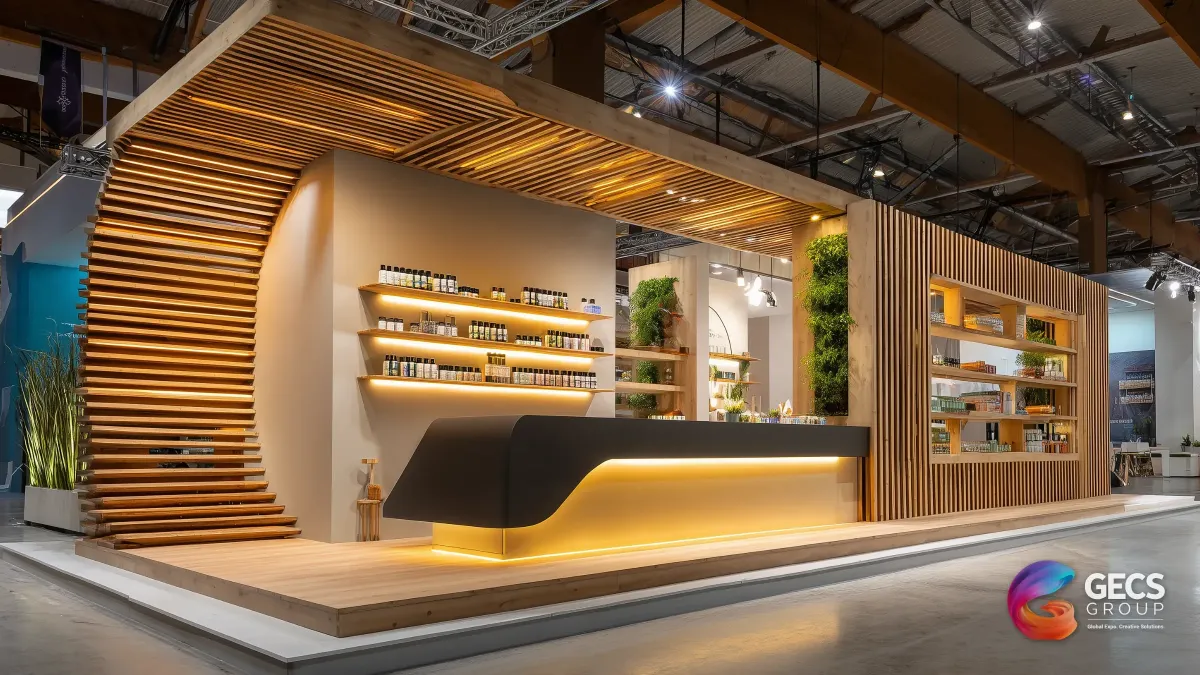
How a custom exhibition stand is made: from design to workshop production, painting, graphics, trial assembly and transport, with indicative costs and lead times.
A custom stand isn’t chosen from a catalogue: it is built around the exhibitor’s brand, products and goals. Custom exhibition stand building combines design, joinery, painting, printing and logistics. Every stage affects the final result and the success of the show.
In this guide we follow a stand from drawing to installation: materials, processes, lead times and costs. For the design side, also read our guide to exhibition stand design.
In short: a custom stand takes on average 6–10 weeks; quality is decided in the workshop, through CNC machining, painting and trial assembly; choose someone who designs and builds in-house, for reliable timing and a single party responsible.
1. Why choose a custom stand
- Uniqueness: shapes, materials and colours designed only for your brand;
- functionality: spaces for products, meetings and storage designed around your needs;
- perceived quality: careful finishes that convey reliability;
- reuse: if well designed, the stand adapts to several shows.
2. Production in the workshop

The stand is born in the joinery workshop. Panels are cut with CNC machines that guarantee millimetre precision, even for curved shapes and complex joints. Structures, walls, counters and platforms are built like real furniture, but designed to be installed and dismantled many times.
| 🧱 Material | ✨ Strengths | 📍 Where it is used |
|---|---|---|
| 🪵Wood and MDF | Workable, free shapes, careful finishes | Walls, counters, displays |
| 🎨Lacquers | Brand colours, premium effect | Counters, visible surfaces |
| 🔩Aluminium and steel | Lightness and load capacity | Structures, trusses, mezzanines |
| 🧵Printed fabric | Large, light, changeable graphics | Graphic walls, lightboxes |
| 💡LEDs and lighting | Atmosphere and product emphasis | Integrated into walls and furniture |
3. Painting and finishes

Visible surfaces are filled, sanded and spray-painted in a booth in the brand colours. Matt or gloss lacquers, wood veneers and durable laminates give the stand its character. A good finish must also withstand repeated transport and installation.
4. Trial assembly in the workshop

Before leaving, the stand is assembled in the workshop. Trial assembly makes it possible to check measurements, alignments, services and finishes, and to correct every detail calmly. At the show, installation is then faster and free of surprises.
5. Graphics and printing

Fabric graphics, printed panels, adhesives and raised lettering complete the stand. Colour must be checked with print proofs, especially for brand colours. Fabric graphics fold, travel light and are easy to change from one show to the next.
6. Packing and transport

Every element is numbered, protected and packed in crates or on dedicated trolleys. A precise loading list simplifies installation and the return to storage. For on-site stages, read our guide to stand build-up and dismantling.
7. Lead times
| 🗓️ Stage | ⏱️ Indicative duration |
|---|---|
| ✏️Concept and 3D renderings | 1–2 weeks |
| 📐Detailed drawings and approvals | 1–2 weeks |
| 🏭Production and painting | 3–4 weeks |
| 🧪Trial assembly and checks | 2–4 days |
| 🚚Transport and installation | 2–5 days |
💬 Want a stand built to measure for your brand? Send us the show, floor area and ideas: we will reply with a concept and an estimate. Ask for an estimate →
8. How much a custom stand costs
| 📏 Size | 💶 Indicative turnkey cost |
|---|---|
| 🟢16–24 m² | €8,000 to €20,000 |
| 🟡30–50 m² | €18,000 to €45,000 |
| 🔵60–100 m² | €40,000 to €90,000 |
| 🟣Double-deck stand | from €80,000 upwards |
The cost depends on materials, technology, graphics and show location. Find out more in how much an exhibition stand costs.
The materials of a custom stand
A custom stand is made from a combination of materials chosen according to image, budget, number of planned reuses and the show’s fire rules. Each has different characteristics, and the best result is often achieved by combining them.
| 🧱 Material | ✅ Advantages | ⚠️ Limits | 📍 Typical use |
|---|---|---|---|
| 🟫Wood and MDF panels | Maximum freedom of shape, lacquered or veneered finishes | Weight, production time | Walls, counters, furniture, niches |
| 🔩Aluminium structures | Lightness, fast installation, reuse | More technical look if not clad | Frames, fabric walls, trusses |
| 🧵Printed fabric | Large, light, washable graphics | Less solid to the touch | Backdrops, backlit walls |
| 🔷Acrylic and glass | Visual lightness, product protection | Scratches, cost of processing | Cases, signs, partitions |
| ⚙️Metal and iron | Sturdiness, industrial style | Weight, cost | Load-bearing structures, stairs, details |
| 🪨Solid surface and laminates | Durability, seamless surfaces | Higher cost | Counter tops, desks |
All materials must have the fire reaction class required by the show, with certificates to submit to the technical office. Find out more in our guide to fire reaction classes and our comparison of plywood and MDF.
Workshop processes
Once the detailed drawings are approved, the workshop organises production. Panels are cut and milled with CNC machines, which guarantee millimetre precision and allow curved shapes, joints, raised lettering and logos. The pieces are then edged, sanded and prepared for painting. Metal parts are cut, welded and powder-coated; acrylic is cut, heat-bent and bonded. In parallel, wiring, LED profiles and service boxes are prepared, so that at the show the electrician only needs to connect them.
The advantage of producing in a single workshop is control: every process is checked before moving to the next, and problems are solved internally without waiting between different suppliers. It is also the best way to guarantee Made in Italy quality, highly appreciated by foreign clients.
An example: a 40 m² stand for the cosmetics sector
A natural cosmetics brand asks for a 40 m² peninsula stand with a reception counter, a display wall with one hundred lit products, a testing station and a small meeting area. The design uses white lacquered panels, oak wood inserts, backlit acrylic shelves and a large fabric graphic with images of the line.
In the workshop, production takes about three weeks: one for cutting and milling, one for painting and assembly, one for services, trial assembly and quality control. The stand is fully assembled in the workshop, shown to the client on a video call, dismantled and packed in numbered crates. At the show the crew installs it in two days. The total cost, including design, production, graphics, transport, installation and dismantling, is around €22,000–30,000, with the possibility of reusing most elements in future editions.
Reusing a custom stand
A custom stand doesn’t have to be used only once. If it is designed in modules, with standard-size walls, independent furniture and replaceable graphics, it can be reconfigured for different shows and different floor areas. Between shows the stand is kept in storage, checked and, if necessary, repaired or updated. This way the initial cost, higher than a standard modular solution, is spread over several events and the cost per show becomes very competitive. For details, read our guide on what to do with the stand after the show.
How to choose who builds the stand
When comparing several offers, it pays to ask to visit the workshop or at least see photos and videos of recent productions, check that the supplier has its own installation crews and an in-house technical office, and check that quotes specify materials, finishes and thicknesses, not just an overall price. It is also useful to ask for references from clients who exhibited at the same show, because every exhibition centre has its own rules and logistical difficulties.
Custom stands made in Italy by GECS Group
We design and produce custom stands in our workshop in Italy, with direct control over every stage: design, production, graphics, trial assembly, transport, installation and storage. We work for shows in Italy, Europe and beyond. Send us the show, floor area and dates to receive a proposal.
The finishes that make the difference
In a custom stand it is the finishes that determine perceived quality. Matt or gloss lacquers in brand colours give a clean, modern look, but require well-prepared panels and protected edges. Natural wood veneers convey warmth and are much appreciated in the food, wine and furniture sectors. Resins and textured paints imitate concrete, stone or metal at much lower weights. High-pressure laminates resist knocks and scratches and are ideal for heavily used counters and worktops.
Added to these are the details: aluminium or brass profiles, handles, backlighting, milled or acrylic raised lettering and logos. A good design concentrates the finest finishes where visitors look and touch — counters, main walls and showcases — and uses simpler solutions in service areas.
Mistakes to avoid when ordering a custom stand
- Ordering too late: with less than five or six weeks you risk rushed work and higher costs.
- Changing the design during production: every change slows the workshop and may mean redoing pieces already made.
- Forgetting reuse: if the stand is to serve other shows, it must be designed in modules from the start.
- Sending artwork at the last minute: printing on fabric or panels needs time and colour checks.
- Neglecting storage: a stand without a store room fills up with visible boxes and coats.
- Not checking the regulations: heights, rigging and materials must be approved by the show.
Summary
A custom stand comes from a clear design, carefully chosen materials, precise workshop processes, trial assembly, accurate packing and an experienced installation crew. Ordered with enough notice and designed to be reused, it offers a unique image and a competitive cost per show.
Quality control before departure
Before packing the stand, the workshop carries out a final check: measurements are verified against the drawings, along with surface flatness, uniformity of lacquers, operation of lights and services, and the match between graphic colours and print proofs. Every element is labelled with a code indicating the stand area and assembly order, and a loading list is prepared that the crew checks on arrival at the show. This largely invisible work is what makes it possible to install a complex stand in a few days without surprises.
Frequently asked questions
Quick answers to the questions we hear most often
Can a custom stand be installed by another crew?
Yes, with clear instructions and assembly drawings; however, the crew that produced it installs it faster and deals better with any unexpected issues.
How much does a custom stand weigh?
It depends on materials and floor area: a 30–40 m² stand in wood and MDF can weigh several tonnes and need a dedicated truck; with aluminium and fabric the weight drops considerably.
Can a custom stand be adapted to a different floor area?
Yes, if it was designed in modules: walls and furniture are added or removed and graphics updated, at a much lower cost than a new stand.
Are the electrical installations certified?
Yes, the installation is carried out by a qualified electrician, who issues the declaration of conformity required by the show.
Can the stand have a raised floor?
Yes, a raised platform hides cables and pipes and gives a perfectly level surface; a ramp for accessibility must be planned, though.
Can I see the stand before the show?
Yes, trial assembly in the workshop lets the client see the finished stand, in person or on a video call, and ask for any touch-ups.
Can a custom stand be reused?
Yes. If designed in modules, it adapts to different spaces and is used for several shows, lowering the cost per event.
Who stores the stand between shows?
We can keep it in our warehouse, with checks and maintenance before every outing.
How far in advance should it be ordered?
Ideally 3 months before the show; the minimum is about 6 weeks.
Do you build stands for shows abroad?
Yes. We build in Italy and install throughout Europe.
Want a custom exhibition stand?
We design and build custom stands in our workshop in Italy, with transport and installation throughout Europe.