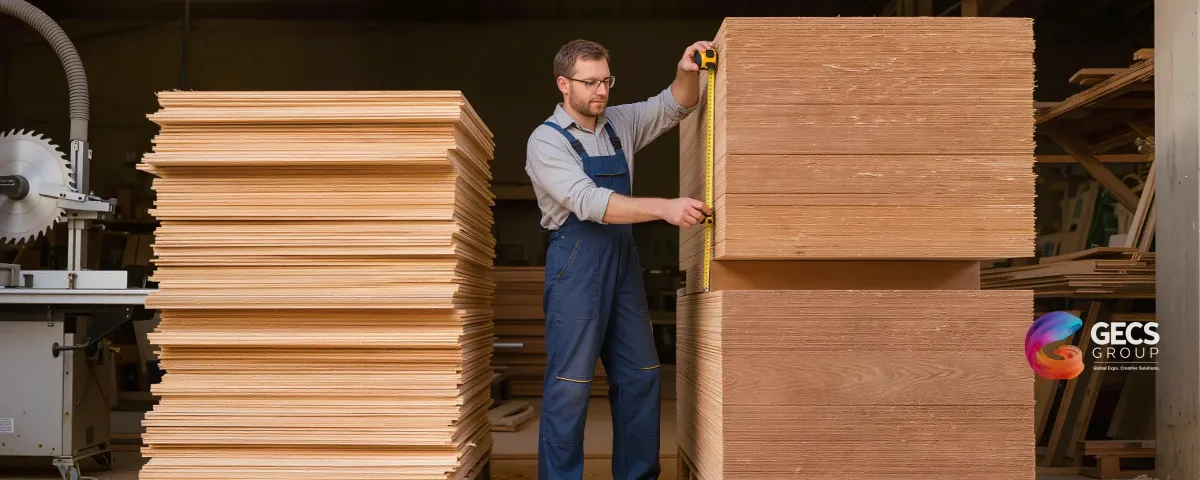
Plywood or MDF: differences in structure, weight, strength, painting, fire-retardant versions, recommended uses for stands and shops and indicative prices.
Plywood and MDF are the two panels most used for exhibition stands, shop furniture and custom furniture. They look similar but behave very differently: one is made of glued wood veneers, the other of pressed fibres. Choosing the right one means sturdier, lighter or more beautiful furniture, and fewer problems at the show.
In this guide we compare structure, weight, strength, painting, humidity, fire-retardant versions, uses and prices. For an overview of materials, read our guide to Made in Italy custom furniture.
In short: plywood is lighter and stronger, holds screws better and withstands repeated assembly; MDF is cheaper, smooth and perfect for painting and routing. They are often used together: a plywood structure with visible surfaces in lacquered MDF.
1. The main differences

| 📋 Characteristic | 🪵 Plywood | 🟫 MDF |
|---|---|---|
| 🧱Structure | Cross-laminated, glued wood veneers | Wood fibres pressed with resins |
| ⚖️Weight (18 mm) | about 9–11 kg/m² | about 13–14 kg/m² |
| 🔩Screw holding | Excellent, even in the edge | Good on the face, weak in the edge |
| 💧Humidity | Good (marine version better) | Swells; moisture-resistant MDF needed |
| 🎨Painting | Visible grain, more primer needed | Smooth surface, perfect lacquer finish |
| 💶Indicative price (18 mm) | €25–60/m² | €10–20/m² |
2. Plywood: when to choose it

Plywood (birch, poplar, okoume) is ideal for load-bearing structures, platforms, mezzanines, walls that are assembled and dismantled many times and furniture that must be light. The layered edge can be left visible as a design feature. Also read our guide to wooden exhibition stands.
3. MDF: when to choose it

MDF is perfect for lacquered surfaces, routing, curved panels and complex shapes: it has no grain and can be machined with great precision. It is the right choice for fronts, doors, counters and painted walls in stands and shops. It comes in moisture-resistant (green), fire-retardant (red or pink) and low-formaldehyde versions.
4. Fire-retardant versions for trade shows

At Italian trade shows, stand materials must have a certified fire reaction class. Both plywood and MDF are available in fire-retardant versions (Euroclass B-s1,d0 or Italian class 1), with a certificate to present to the show. They cost 30–80% more, but without the certificate the stand may not be approved.
💬 Not sure which panel to use for your stand or furniture? Send us the design: we will choose the right material, thickness and finish with you. Ask for advice →
5. Recommended uses in stands and shops

| 🛠️ Element | 🪵 Plywood | 🟫 MDF |
|---|---|---|
| 🧱Structures, platforms, mezzanines | Recommended | Not recommended |
| 🗄️Doors, drawers, fronts | Possible | Recommended |
| 🎨Lacquered and routed walls | Possible | Recommended |
| 🔥Reusable stands | Recommended | With reinforcements |
6. The mixed solution

Quality stands and furniture often combine the two materials: a light, strong plywood frame, cladding in lacquered or veneered MDF, and tops in laminate or solid surface. Also read our guide to the mixed aluminium, MDF and fabric stand.
7. Weight and transport: a calculation that changes the quote
A panel's weight depends on the material's density and the thickness. With the thickness most used in stands, 18 mm, each square metre of panel contains 0.018 m³ of material. Multiplying by the density gives the weight per square metre. The figures are indicative and vary between manufacturers.
| 🪵 Panel | ⚖️ Indicative density | 📏 Weight per m² (18 mm) | 🧱 3 × 2.5 m wall |
|---|---|---|---|
| 🌳Poplar plywood | about 450 kg/m³ | about 8 kg | about 61 kg |
| 🌲Birch plywood | about 680 kg/m³ | about 12 kg | about 92 kg |
| 🟫Standard MDF | about 750 kg/m³ | about 13.5 kg | about 101 kg |
| 🟥Fire-retardant MDF | about 800 kg/m³ | about 14.5 kg | about 108 kg |
For a single panel the difference seems small, but in a 50 m² stand with walls, counter and platform it amounts to hundreds of kilos. More weight means a bigger van, more people for installation and more time for handling at the show. That is why, in stands that travel a lot, we use poplar for hidden structures and reserve MDF for the surfaces visitors see and touch.
8. There is no single plywood (or single MDF)
When comparing prices you need to know which panel you are talking about. Very different products share the same name.
The most common types of plywood
- Poplar: light and cheap, ideal for internal structures, platforms and crates. The surface is soft and not well suited to visible lacquering.
- Birch: harder and more stable, with a thin, regular layered edge often left visible in design furniture.
- Okoume: light with good strength, also used in boatbuilding.
- Marine: bonded with water-resistant glues, for damp environments or outdoor set-ups.
- Fire-retardant: treated to achieve the fire reaction class required at shows.
Types of MDF
- Standard: the most common, excellent for lacquering and routing.
- Moisture-resistant (often green in the core): better resistance to humidity, useful for bathrooms, kitchens and shops with variable air-conditioning.
- Fire-retardant (red or pink core): the required choice for many stand parts.
- Lightweight: reduced density, less weight but weaker edges.
- Through-coloured: the colour runs through the whole thickness, so routed edges don't need painting.
9. Formaldehyde and emissions: what changes from 2026
Both plywood and MDF are bonded with resins that can release formaldehyde. For wood-based panels the reference standard is EN 13986, and Europe has used emission class E1 for years. From 6 August 2026 the European restriction under Regulation (EU) 2023/1464 applies, setting a stricter emission limit for furniture and wood-based articles placed on the market.
In practice, for anyone buying furniture for shops, showrooms or stands, it means one simple thing: ask the supplier for low-emission panels and the related documentation. It matters most in enclosed spaces used every day, such as shops and offices; at a trade show stand exposure is short, but the panels are often reused for years.
10. Machining and finishes: what works best on each panel
| 🛠️ Process | 🪵 Plywood | 🟫 MDF |
|---|---|---|
| 🎨Gloss or matt lacquer | Possible, but the grain can show through | Excellent: smooth, even surface |
| 🌀Decorative CNC routing | Visible layered edge, technical look | Ideal for waves, reliefs and bas-reliefs |
| 🪚Exposed edge | Attractive on birch, left natural | Must be edged or lacquered |
| 🧴Real wood veneer | Excellent | Excellent, very flat surface |
| 🔩Screws and hinges in the edge | Hold well | Dowels or dedicated hardware needed |
For very hard-wearing surfaces such as checkout counters and worktops, high-pressure laminates or materials like solid surface are applied over an MDF or plywood substrate. The panel underneath still matters: it must be stable and not warp over time.
11. Fire reaction: the documents to have at the show
At Italian trade shows the organiser may ask for certification of the materials used in the stand. Two systems are in use today: the traditional Italian classification (class 0, 1, 2…) and the European Euroclasses under EN 13501-1 (for example B-s1,d0). Each show's technical regulations state which class is required for walls, ceilings, floors and fabrics.
In practice, before the show you need:
- the panel's fire reaction certificate, issued by the manufacturer;
- the declaration of conformity between the certified material and the one actually installed in the stand;
- the same certificates for fabrics, carpet and graphics, which are often forgotten.
We deliver these documents together with the stand, so exhibitors don't have to hunt for them at the last minute during inspections.
12. Which panel for which element: summary table
| 📦 Element | ✅ Recommended choice | 💡 Why |
|---|---|---|
| 🧱Stand wall structure | Fire-retardant poplar plywood | Light and holds screws well |
| 🖼️Visible lacquered walls | Fire-retardant MDF | Perfect surface for paint |
| 🛒Checkout counter and reception | Plywood structure, cladding in lacquered MDF or laminate | Strength plus a fine finish |
| 📚Long, loaded shelves | Birch plywood | Doesn't sag under weight |
| 🌊Routed decorative panels | MDF | Clean routing and even lacquer |
| 💧Furniture in damp environments | Marine plywood or moisture-resistant MDF | Doesn't swell |
13. How to recognise a quality panel
Two panels of the same type and thickness can have very different prices, and there is usually a reason. Here are the checks we carry out in the workshop when a new batch arrives.
- Consistent thickness: measured at several points with calipers. Differences of a few tenths create steps at wall joints.
- Flatness: laid on a flat surface, the panel must not bow. A curved panel stays curved once installed.
- Plywood edge: the layers must be regular and without voids. Internal voids weaken screw holding.
- MDF surface: smooth and flawless, otherwise lacquering needs more coats of primer.
- Markings and documents: emission class, any fire reaction class and production batch.
Saving on the panel almost never pays: the material cost is a small part of the price of finished furniture, while machining, painting and installation cost much more and are wasted on a poor substrate.
14. Reuse, storage and maintenance of wooden elements
Many stands are set up several times a year. The material chosen affects durability. Plywood walls withstand repeated assembly and dismantling better, because screws keep holding even after many cycles. Lacquered MDF, by contrast, is more delicate on the edges and must be protected during transport.
Some practical rules to make elements last:
- store panels flat or upright on racks, never leaning diagonally;
- keep them in a dry warehouse, away from sources of humidity;
- pack lacquered edges with cardboard or foam protectors;
- use metal threaded inserts at points that are dismantled often;
- schedule small paint touch-ups between shows.
With these precautions a well-designed wooden stand can be reused for several seasons, changing only the graphics and small elements.
Mistakes to avoid
- MDF for load-bearing structures. It is heavy and breaks at the edges.
- Cheap plywood for lacquering. The grain shows under the paint.
- Non-fire-retardant panels at shows. The stand risks not being approved.
- Standard MDF in damp environments. It swells and warps.
- Screws in the edge of MDF. Dowels or dedicated hardware are needed.
Frequently asked questions
Quick answers to the questions we hear most often
Is plywood or MDF better?
It depends on the use: plywood for structures and lightness, MDF for lacquered surfaces and precise machining.
Which costs less?
MDF, roughly €10–20/m² compared with €25–60/m² for 18 mm plywood.
Are there fire-retardant versions?
Yes, for both, with a fire reaction certificate valid for trade shows.
Which is lighter?
Plywood, about 25–30% lighter than MDF of the same thickness.
Do you produce furniture and stands in both materials?
Yes, in our workshop in Italy, with installation throughout Italy and Europe.
How much does an 18 mm MDF panel weigh?
About 13–14 kg per square metre, compared with about 8 kg for poplar plywood and about 12 kg for birch plywood.
Does MDF release formaldehyde?
Like plywood, it contains resins. It is best to choose low-emission panels with manufacturer documentation, especially for shops and offices.
Which panel lasts longer in a reused stand?
Plywood withstands repeated assembly and dismantling better because screws keep holding after many cycles. Lacquered MDF is more delicate at the edges and must be protected in transport.
What does B-s1,d0 mean?
It is a fire reaction Euroclass under EN 13501-1: B means a limited contribution to fire, s1 low smoke production and d0 no flaming droplets.
Can plywood be lacquered?
Yes, but for a perfectly smooth lacquer finish MDF gives better results, because on plywood the grain can show through the paint.

Want furniture and stands made with the right materials?
We produce in Italy stands and shop furniture in plywood, MDF, laminates and solid surface, with certified fire-retardant versions and turnkey installation.