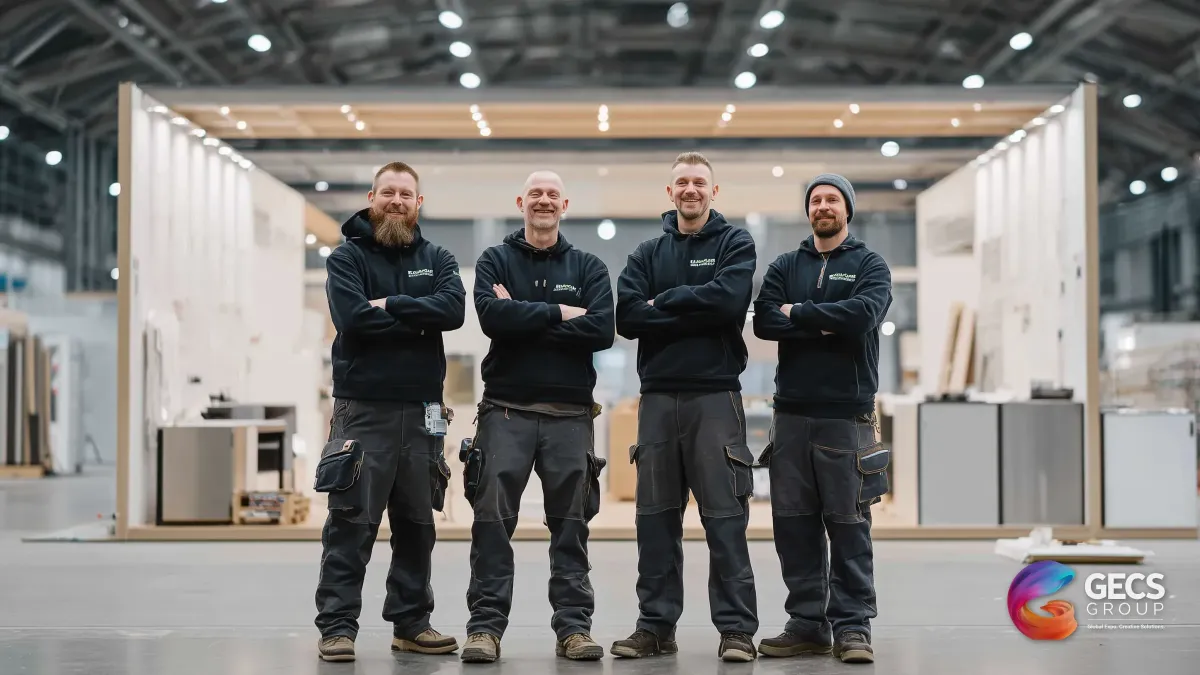
What exhibition stand and shop fitters do, which services they offer, how to compare them and which questions to ask before handing over the project.
Behind a stand ready for the show’s opening or a shop opened on time is the work of the fitters: designers, carpenters, painters, electricians and installers who turn a drawing into a real space. Choosing the right fitter means sleeping soundly; choosing the wrong one means delays, extra costs and embarrassment in front of clients.
In this guide we look at what exhibition stand and shop fitters do, how to assess them and which questions to ask. If you are looking for a company for your shop, also read how to choose a shop fitting company.
In short: choose fitters with their own workshop and crews, a portfolio similar to your project and a detailed quote; ask who is responsible if problems arise at the show or on site, and check insurance and written timelines.
1. Who fitters are
They are companies that create temporary and commercial spaces: exhibition stands, shops, shop-in-shops, corners, showrooms, events. Some only do installation, others handle the whole process, from design to production through to support. For the client this makes a big difference.
2. Exhibition stand fitters

They work to extremely tight deadlines: build-up at the show lasts a few days and the opening doesn’t move. They must know exhibition centre regulations, access times, safety and logistics, in Italy and abroad. Their work continues with dismantling and often with storing the stand. For details, read our guide to stand build-up and dismantling.
3. Shop fitters

In a shop, precision and coordination with other works matter: services, floors, walls. Shop fitters install custom furniture, shelving, checkout counters, showcases and lighting, often at night or with the shop closed for a few days.
| 🧩 Service | 🎪 Exhibition stands | 🏬 Shops |
|---|---|---|
| ✏️Design | Concept, 3D renderings, show paperwork | Layout, 3D renderings, furniture design |
| 🏭Production | Walls, counters, platforms, graphics | Custom furniture, shelving, checkout |
| 🚚Logistics | Transport to the show, storage | Delivery to the shop |
| 🔧Installation | A few days before opening | Often at night or with the shop closed |
| 🛠️Support | During the show and dismantling | Warranty and maintenance |
4. Project management and timing

A good fitter has a project manager who coordinates production, transport and crews and communicates clearly with the client. Ask for a written schedule with key dates: design approval, production, delivery, installation.
5. Own workshop and crews

Fitters with an in-house workshop control quality and timing: if a piece needs changing, they do it the same day. Their own crews know the materials and work to the same standards. Those who subcontract everything add steps, costs and risks.
💬 Looking for a fitter for your next show or your shop? Tell us about the project: we will reply with a proposal and a free estimate. Ask for a proposal →
6. How to assess a fitter

| 🔍 What to check | ✅ Why it matters |
|---|---|
| 🗂️Portfolio of similar work | Experience in your sector and at your size |
| 🏭Production workshop | Direct control of quality and timing |
| 👷Own installation crews | Less subcontracting, more accountability |
| 📄Detailed quote | Clear items, no hidden costs |
| 🛡️Insurance | Cover for damage to people and property |
| 💬References and communication | Quick answers when needed |
7. Questions to ask before signing
- Who will be my contact from start to finish?
- Do you produce in-house or subcontract?
- What is included in the price: transport, installation, dismantling, graphics?
- What happens if an item arrives damaged or wrong?
- What are the guaranteed dates for delivery and installation?
8. Warning signs
- a price much lower than the others without explanation;
- a generic quote with no materials or quantities;
- no photos of real work, only stock images;
- vague timelines or impossible promises;
- no written contract or insurance.
Questions to ask the fitter
- Do you have your own production workshop? Those who produce in-house control quality and timing.
- Are the installation crews in-house? Own crews know the furniture and work faster.
- Do you have experience at the show or shopping centre in question? Every venue has different rules, hours and access.
- Who follows the project from start to finish? A single project manager avoids lost information.
- What is included in the quote? Design, graphics, services, transport, installation, dismantling, storage, paperwork.
- Which certificates do you issue? Electrical declaration of conformity, fire reaction certificates for materials.
- How do you handle unexpected issues? Spare parts, availability during the show, response times.
- Are you insured? Public liability insurance for damage during the works.
The answers to these questions say much more than a photo catalogue. A serious fitter answers precisely and puts the main terms in writing. For contractual details, read our guide to the contract with the stand builder and stand insurance.
How to compare quotes
Comparing quotes from different fitters is hard if each describes the work in its own way. That is why it pays to send everyone the same brief and ask for itemised offers. The table below shows the items to check.
| 🧾 Item | 🔍 What to check | ⚠️ Risk if missing |
|---|---|---|
| 📐Design and detailed drawings | Number of revisions, renderings, paperwork with the show or centre | Extra costs for every change |
| 🪑Structures and furniture | Materials, thicknesses, finishes, quantities | Lower quality than expected |
| 🖼️Graphics | Printing, material, application, who supplies the files | Graphics paid for separately |
| ⚡Electrical installation | Light points, sockets, panel, certification | Insufficient or uncertified installation |
| 🚚Logistics | Return transport, unloading, forklift | Unexpected transport invoices |
| 🔧Installation and dismantling | Days, crews, any night work | Surcharges once the show has started |
| 🏬Storage and reuse | Annual cost, checks, maintenance | Damaged stand or one to redo |
Sometimes a higher quote is actually better value, because it includes items others exclude. The comparison must be made on the real total, not on the first figure at the bottom of the page.
Local fitter or fitter working throughout Europe
A local fitter knows the nearby exhibition centre well and can respond quickly, but often has less experience with distant shows or abroad. A fitter working in several countries is used to different logistics, regulations and languages, and can follow a company to all its shows with the same stand and the same quality standard. For those exhibiting in several countries, a single partner simplifies a lot: one contact, one stand to manage, one storage facility. For abroad, read our guide to the Italian stand builder for shows in Europe.
An example of ongoing collaboration
A mechanical components company takes part in five shows every year: two in Italy, two in Germany and one in France, with floor areas from 24 to 96 m². Instead of looking for a different supplier each time, it entrusts everything to a single fitter. A modular stand is designed with recognisable elements — a counter, a backlit wall with the logo, product displays — that adapts to all floor areas. Between shows the stand stays in storage, is checked and updated with new graphics.
The result is a consistent image at every show, much shorter preparation times and an average cost per event about a third lower than in previous years, when each stand was built from scratch. The company deals only with content and products; everything else is managed by the fitter.
Shop fitters: what changes compared with shows
Fitting out a shop requires skills partly different from those needed for a stand. A stand lasts a few days and must be installed quickly; a shop must last years, withstand daily use and comply with more complex building, services and safety regulations. A shop fitter must be able to coordinate masonry, electrical and air-conditioning work, floors, suspended ceilings, furniture and signage, often in premises with structural constraints or in historic centres with precise rules.
In shopping centres, moreover, you must follow the centre’s rules, get design approval from the technical management, work at set hours and coordinate with other sites. Those with experience in both shows and shops have an advantage: they are used to the tight deadlines of shows and the durability required by retail. Also read our guide to shop fitting.
The value of Made in Italy
For many foreign companies, choosing an Italian fitter means access to a tradition of craftsmanship, design and quality of finishes recognised worldwide. The Italian workshop works wood, metal, glass and composite materials with an attention to detail that shows above all up close, in counters, displays and joints. Added to this is the ability to design spaces that are elegant and functional at the same time. For an international brand, appearing at a show with a Made in Italy stand is also a message of quality to its own clients.
The right time to contact the fitter
For a show, the ideal time to contact the fitter is three to six months beforehand: there is time for the design, revisions, paperwork with the show organiser and production without rushing. For major international shows it is better to start even earlier, because the best crews and vehicles are booked early. For a shop, you usually start three to four months before the planned opening, also allowing for any municipal permits. Contacting the fitter at the last minute is possible, but it reduces choices and often increases costs.
Positive signs of a good fitter
Besides warning signs, there are positive signs to recognise. A good fitter asks questions: they want to understand goals, products, budget and timing before proposing solutions. They propose alternatives, explaining the advantages and costs of each, instead of always pushing the most expensive solution. They show stands and shops they have built, with real photos and not just renderings, and gladly accept a workshop visit. They state clearly who the project contact will be and how communication will work during the works. Finally, after handover, they ask for feedback and remain available for small interventions: the sign of someone aiming for a long collaboration, not a single job.
Summary
Choosing the right fitter means assessing workshop, crews, experience at the venues you work in, clarity of quotes and the ability to follow the project from start to finish. A good partner becomes a long-term ally who knows the brand and helps you improve at every show or opening.
Frequently asked questions
Quick answers to the questions we hear most often
Can a fitter handle several shows at the same time?
Yes, if it has several crews and an organised technical office; it is still worth asking what other sites it has scheduled on the same dates.
How can I tell if a fitter is reliable?
Ask for recent references, visit the workshop if possible, check that they have their own crews and that the quote is clear item by item. Prompt answers during negotiation are already a good sign.
Can the fitter also handle graphics?
Yes, many fitters offer layout, file adaptation and printing of graphics, ensuring correct sizes and colours consistent with the brand.
Is it possible to entrust only part of the work?
Yes: you can entrust installation only, production only or design only. However, a single party responsible for the whole process reduces the risk of errors and delays.
What happens if the show is cancelled?
It depends on the contract: it is worth agreeing beforehand how work already done, materials purchased and penalties are handled, and considering cancellation insurance.
Does the fitter offer a warranty on shop furniture?
A serious fitter guarantees furniture and installations for an agreed period and carries out adjustments and small repairs after opening.
Is a local fitter better, or one that works throughout Europe?
For shows abroad, choose someone with international experience and crews used to travelling; for a shop, speed of response also matters.
How far in advance should I contact the fitter?
For a show 2–3 months before, for a shop 2–4 months before opening.
Does the fitter also handle the show paperwork?
The best ones do: design for approval, material certificates and declarations of correct installation.
Do you also work abroad?
Yes. Our crews have installed stands throughout Europe, the United Kingdom and the Middle East.
Looking for reliable fitters?
We design, produce in our workshop in Italy and install with our own crews exhibition stands and shops throughout Europe.