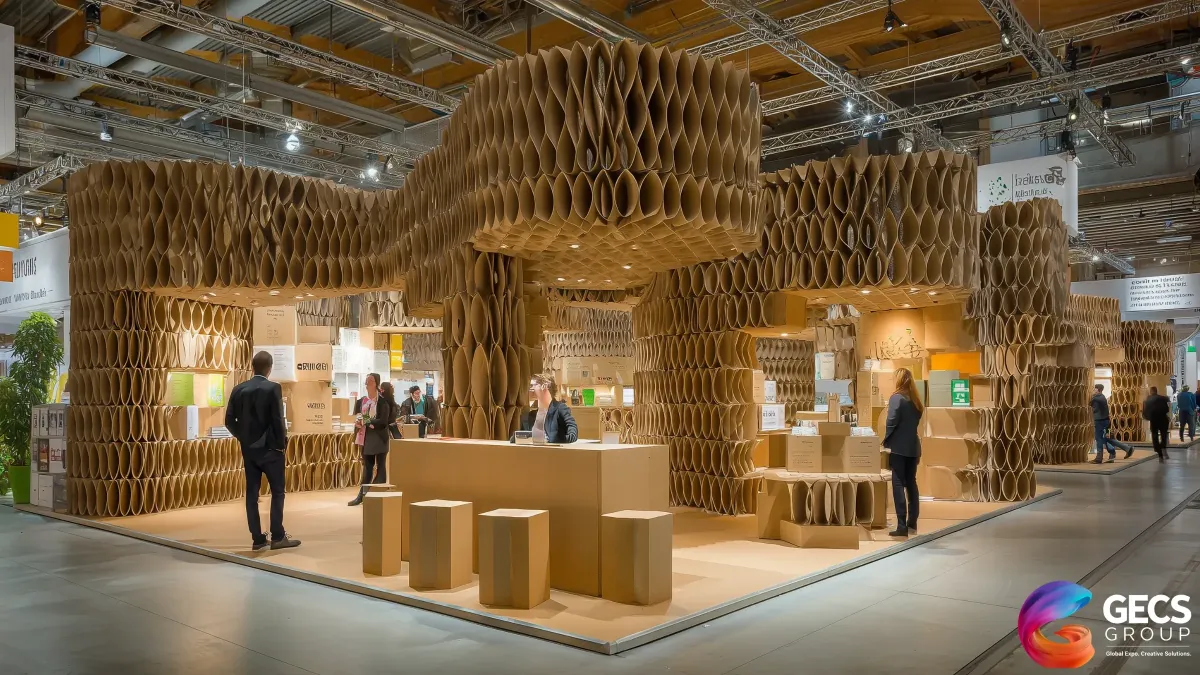
Light, printable and recyclable: how a cardboard exhibition stand is built, how much it can take, what you need for fire checks and when it is the right choice.
A cardboard exhibition stand always has the same effect: visitors come closer, touch the walls and ask whether it is really cardboard. That is its first advantage. The second is more practical: ultra-light, printable panels that slot together and, at the end of the show, go into paper recycling instead of landfill.
Cardboard is not suitable for everything, though. In this guide we look at what kind of cardboard we mean, how strong it really is, what shows require for fire safety, what can be built, how it is installed and when it pays compared with aluminium and wood. If you are interested in sustainable solutions in general, also read the 2027 stand trends.
In short: a cardboard stand is built with honeycomb cardboard panels, rigid and light, printed directly. It works very well for small and medium stands, counters, displays and furniture, especially for brands that communicate sustainability. You need board with the fire reaction class required by the show and some care with humidity, knocks and loads.
Cardboard, wood and aluminium compared
| 📌 Aspect | 📦 Honeycomb cardboard | 🪵 Wood and MDF | 🔩 Modular aluminium |
|---|---|---|---|
| ⚖️Weight | Ultra-light | Heavy | Light |
| 💪Knocks and loads | Good if well designed, edges are vulnerable | High | High |
| 💧Humidity and liquids | The weak point, must be protected | Good with the right finishes | Excellent |
| 🖨️Printing | Direct on the panel, full colour | UV print or cladding | On fabric or panels |
| ♻️End of life | Recycled in the paper stream | Recovery of wood and panels | Reused for years, then recycled |
| 🔁Reuse | Limited: a few outings | Possible if modular | Very high |
1. What cardboard we mean: honeycomb, corrugated and tubes

Stand cardboard is not the stuff of moving boxes. The main material is honeycomb cardboard: two sheets of board glued to a core of hexagonal paper cells. The result is a rigid, flat and very light panel, available in various thicknesses, which is cut to size and slotted together without screws.
Alongside honeycomb board, multi-wall corrugated cardboard is used for folded elements and small displays, and cardboard tubes, strong in compression, for columns, table legs and structures. In many projects cardboard is combined with a light wood or aluminium frame where bigger loads or heights are needed.
2. How strong it really is

Well designed, honeycomb cardboard is surprisingly sturdy: counters, seats, shelving and walls easily withstand the use of a show. Strength depends on geometry more than material: vertical panels, ribs, properly sized slots and protected edges make the difference. A panel laid flat and loaded in the middle, on the other hand, will bend.
The real enemies are two: water and knocks on the edges. A spilled glass or cleaning with a wet cloth leaves marks, and trolleys during build-up can crush the edges. That is why cardboard counters are protected with laminate tops or films, corners with profiles, and heavy products rest on reinforced shelves.
3. Fire reaction: is cardboard allowed at shows?

It is the first question anyone considering a cardboard stand asks, and the answer is yes, on one condition. As with wood and fabrics, Italian show regulations require materials with an adequate fire reaction class, generally class 1 or the equivalent Euroclass. Ordinary cardboard doesn’t reach it, but there are fire-retardant honeycomb boards that achieve the class 1 required at exhibitions.
In practice the board must be ordered fire-retardant from the outset, with the manufacturer’s certificate, to be kept available for the show organiser together with the materials declaration. Glues, paints and films must also be compatible. Before designing, always check the venue’s technical regulations: some shows have specific rules for combustible materials used in large quantities.
4. Printing and finishes

Graphics are one of cardboard’s strengths. Panels are printed directly with flatbed UV printing in full colour, then plotter-cut even into complex shapes: cut-out letters, product silhouettes, holes and slots. No films or extra panels are needed, and the printed surface is matt, with no glare under show lighting.
You can leave the cardboard exposed, with its natural colour and the honeycomb edge as a design element, or cover it completely with graphics. On the most exposed parts, protective varnishes or laminations are added, always compatible with the fire reaction class.
5. What can be built in cardboard

Almost the whole stand can be built in cardboard: self-supporting slot-together walls, counters and receptions, shelved displays, totems, cubes and plinths for products, tables, seats, partitions and even light suspended elements. It is also ideal for point-of-sale materials and temporary stores, where a striking fit-out is needed for a few weeks.
It works less well for very tall walls, mezzanines, structures carrying heavy screens and outdoor elements. In those cases it is combined with other materials: an aluminium structure with cardboard infills, or cardboard furniture inside a modular stand. For transparent displays, see our guide to custom acrylic displays.
6. Installation and transport

Cardboard travels flat: a small stand often fits on a few pallets and a van, saving on transport and emissions. At the show, panels slot together, almost always without tools, and the stand takes shape in a few hours.
Two practical warnings. Panels must be protected from rain during loading and unloading and stored in a dry place. And installation must be done carefully, without forcing the slots, because a damaged slot is not easy to repair. The general site rules are the same as for any stand: you will find them in our guide to exhibition stand build-up and dismantling.
7. End of life: recycling and reuse

At the end of the show the cardboard stand is dismantled, flattened and, separated from any plastic or metal parts, goes into the paper recycling stream. It is the most obvious environmental advantage, and it is also easy to explain to customers and visitors. The guidelines of Salone del Mobile.Milano, for example, encourage the use of recycled or FSC or PEFC certified cardboard and wood.
Reuse is possible but limited: well-treated cardboard can handle a few outings, especially for furniture and displays, while walls tend to get damaged in transit. Those who exhibit many times a year often get a better environmental balance with an aluminium structure reused for years and completed with replaceable cardboard elements.
8. When it pays, and when it doesn’t

A cardboard stand pays when sustainability is part of the message, when the stand is small or medium, when it is needed for one or a few outings and when graphics matter a lot. It is a strong choice for startups, green brands, natural cosmetics, food, publishing and corporate events, but also for temporary stores and product launches.
It pays less if the stand must last many shows, carry significant loads, be very tall or stand in humid or outdoor environments: there the most sensible choice is a hybrid or a modular aluminium stand. On cost, cardboard is not automatically the cheapest material: it depends on the amount of printing, shapes and protection. Price ranges are in our guide on how much an exhibition stand costs.
Is it the right stand for you?
Six questions to find out in a few minutes whether cardboard suits you.
| ❓ Question | ✅ If the answer is yes | ↩️ If the answer is no |
|---|---|---|
| 🌱Is sustainability a brand message? | Cardboard is a great talking point | Also consider wood or aluminium |
| 📏Is the stand small or medium? | Cardboard works for walls too | Cardboard for furniture, aluminium structure |
| 🔁Will you use it once or twice? | Cardboard is good value | A reusable structure is better |
| 🏋️Do you display heavy products or screens? | You need reinforced shelves or a frame | Cardboard without problems |
| 💧Will there be liquids or humidity on the stand? | Protect tops and surfaces | Cardboard can be left exposed |
| 🖨️Are graphics the star? | Direct printing and cut-out shapes | Natural cardboard works too |
Mistakes to avoid with cardboard
- Using non-fire-retardant board or board without a certificate: at the show inspection the stand is stopped.
- Loading panels flat instead of designing them vertically or with ribs.
- Leaving counters and tops unprotected from liquids and scratches.
- Transporting it in the rain or storing it in a damp warehouse.
- Forcing the slots during installation and dismantling.
- Calling it eco-friendly without explaining material origin and end of life.
An example: a 16 m² cardboard stand for a startup
A startup that makes compostable packaging takes part in a packaging show for the first time. It has a limited budget and wants the stand itself to tell its philosophy. The design includes honeycomb cardboard walls printed in four colours, a cardboard counter with a reinforced top, two stepped displays for samples, pressed cardboard stools and a large three-dimensional suspended logo. All elements slot together without screws or glue and are delivered in flat packs.
Installation takes half a day for two people, without tools. The stand is used at three shows in the same year, then the graphic walls are recycled and replaced, while the counter and displays remain. The total cost of the first edition, including design and printing, comes to roughly €4,000–7,000. The stand also becomes a conversation starter: many visitors stop precisely to touch the materials and ask how they are made.
How to communicate a cardboard stand
A cardboard stand attracts attention, but its value is worth explaining. A small panel can state the type of board used, the percentage of recycled material, how many times the stand will be reused and how it will be recycled at the end. Staff should also be able to explain it in a few words, because the questions will come. Avoiding generic slogans and preferring concrete data makes the message credible and consistent with the image of an environmentally conscious company. Also read our guide to the sustainable exhibition stand.
Frequently asked questions
Quick answers to the questions we hear most often
Does cardboard get damaged by humidity?
Treated honeycomb cardboard withstands the normal humidity of a hall; it must however be protected from spilled liquids and should not be used outdoors without cover.
Can screens be hung on a cardboard wall?
Light monitors yes, with supports designed to spread the weight; for large screens a dedicated wood or metal structure is better.
How long does it take to produce a cardboard stand?
Usually two to three weeks between design, colour proof, printing and cutting, less than a custom wooden stand.
Is a cardboard stand safe?
Yes, if it is built with certified fire-retardant honeycomb board and designed for the expected loads. Counters, walls and furniture easily withstand the use of a show.
Is cardboard allowed at all shows?
Normally yes, provided it has the fire reaction class required by the technical regulations, generally class 1 or the equivalent Euroclass. Always check the venue’s regulations before designing.
How many times can a cardboard stand be used?
Well-treated furniture and displays can handle a few outings; walls get damaged more easily in transit. For many shows a year, a reusable structure with cardboard elements is better.
Does a cardboard stand cost less?
Not always. The material is cheap, but printing, cutting, protection and design weigh heavily. The biggest savings are on transport, installation and disposal.
Do you make cardboard stands and displays?
Yes: we design the stand, choose certified materials for the show, handle printing and cutting and install it in Italy and Europe, also combined with aluminium and wood. See the turnkey exhibition stand.
Interested in a cardboard or hybrid stand?
We design and build sustainable stands in cardboard, wood and aluminium, with certified materials and installation in Italy and Europe.