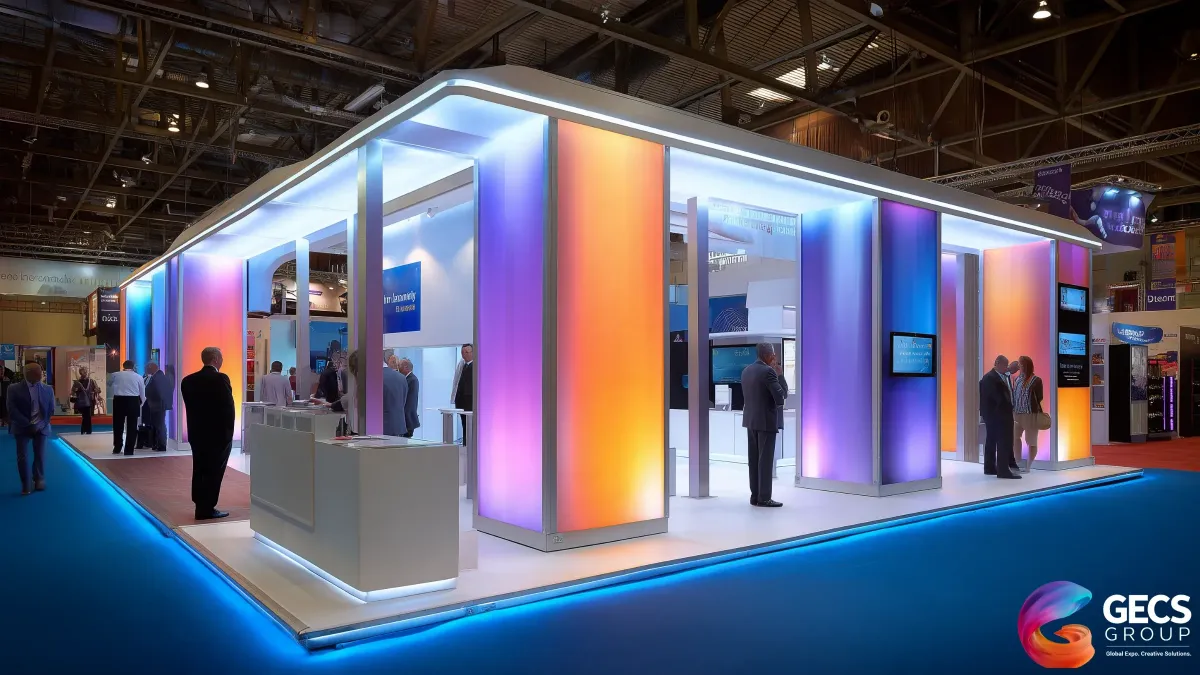
Profiles or frames, fabric or panels, 3 or 6 metres high: how an aluminium exhibition stand works, how many times it can be reused and when it beats timber.
Anyone looking for an aluminium exhibition stand usually wants two things: a stand that goes up quickly and one that can be used more than once. That is exactly what modular systems do best: light, precise profiles and frames that assemble without glue or paint and, at the end of the show, go back into their cases ready for the next one.
This guide explains how modular aluminium stands work, which systems exist, how high you can build, how walls are finished, how long build-up takes and when aluminium really makes more sense than a timber stand. If you are still deciding on the overall approach, start with our guide to exhibition stand design.
In short: aluminium pays off when you exhibit several times a year, when the floor space changes from show to show and when you need fast build-ups. Systems fall into profiles with panels and frames for tension fabric; together they cover almost everything, from 2.5-metre walls to 6-metre structures. For free-form shapes and craft finishes timber is still the better fit, often as a hybrid.
Aluminium, timber or hybrid: a quick comparison
| 📌 Aspect | 🔩 Modular aluminium | 🪵 Custom timber | 🔀 Hybrid |
|---|---|---|---|
| ♻️Reuse | High: the structure lasts many shows | Low, unless designed as modules | High for the structure, timber is renewed |
| 📐Shapes | Straight lines and standard curves | Free, even organic | Free where needed, modular elsewhere |
| 🔧Build-up | Fast, often tool-free | Longer, with carpenters on site | In between |
| 🎨Finishes | Fabric, panels, lightboxes | Lacquer, veneer, laminate | The best of both |
| 🚚Weight and transport | Light, compact cases | Heavy and bulky | Medium |
| 💶Cost over time | Falls from the second show | Repeats at every show | Falls for the modular part |
1. Why aluminium works so well at trade fairs

Aluminium weighs about a third of steel, does not rust and can be extruded to tight tolerances, which is why it has been the reference material for modular systems for more than fifty years. An anodised profile comes out of its case exactly as it went in, connects with tension locks or push-fit joints and carries walls, fabric, shelves and lights without being repainted for every show.
Sustainability matters too, and organisers and clients ask about it more and more. The structure is reused for years and recycled at the end of its life: some manufacturers state up to 90% recycled aluminium in their profiles. The result is a stand with far less build-up waste, a real argument at venues such as Fiera Milano, where plasterboard has not been allowed for stand walls and ceilings since 2024.
2. Profiles or frames: the two families of systems

Modular systems come in two main families. Profile systems such as Octanorm Maxima use uprights and beams with grooves on several sides that take panels (typically 16 mm), glass, shelves or fabric. Maxima comes in 40, 80, 120 and 160 mm profiles: the 80 size is the most common for complete stands and, in the configurations the manufacturer specifies, reaches 6 metres in height.
Frame systems such as the Omni-55 Pro by the Belgian manufacturer Aluvision use perforated modular frames that join without tools and are covered with tension fabric graphics or panels, even on both sides. The fabric has a silicone edge that slides into the frame groove, giving a smooth surface with no visible screws. Many stands combine both families: profiles where you need doors, shelves and glass, frames where you need large graphic surfaces.
3. Heights, spans and double-deck stands

At many shows the standard perimeter wall is 2.5–3 metres high. These are also the heights of the Maxima-based packages that Messe Stuttgart, for example, offers exhibitors, in 250 cm and 300 cm versions. With stronger profiles and floor plates you can go up to 5–6 metres, useful for back walls visible from the far end of the hall and for tall signage without ceiling rigging.
To double your floor space there are double-deck stands on aluminium structures: Aluvision’s Flexdeck system, for example, allows free spans of up to 6 metres without cross bracing. Always check the venue rules, though: maximum heights, distances and two-storey structures must be approved by the organiser. At Fiera Milano Rho, for example, an upper deck must stay at least 1.5 metres from the aisle line. More on this in our guide to custom exhibition stand construction.
4. How the walls are finished

Very different finishes fit on the same structure. Printed tension fabric is the lightest and quickest to change; rigid panels are needed wherever shelves, screens or frames will hang; fabric lightboxes turn a wall into a sign; frosted or clear acrylic separates a meeting area without closing it off completely.
The practical tip is to decide early where loads and sockets will go: a 55-inch screen or a shelf full of products needs reinforcement and panels, not fabric. All infill materials must have the fire rating required by the show’s technical regulations, in Italy usually class 1 or the equivalent Euroclass, with a certificate kept on the stand. You will find more on fabric and light walls in our guide to fabric and backlit walls.
5. Build-up: time and crew

The clearest advantage of modular systems shows on site. Profiles and frames arrive numbered, with an assembly plan, and go together with few tools or none. A medium-sized modular stand is often built in a single day by a small crew, while a timber stand of the same size usually takes several days of work in the hall.
Fewer build-up hours mean lower crew costs, less travel and less risk of overrunning the venue’s schedule. Electrical connections, inspections and graphics still have to be planned: we explain how the work on site is organised in our guide to exhibition stand build-up and dismantling.
6. Reuse, cases and storage

An aluminium stand lives in cases: every part has its place, fabric graphics are folded or rolled, and everything takes up a fraction of the volume of a timber stand. Between shows the stand builder stores it, checks the parts, replaces damaged ones and reconfigures it for the new plot: a 6×4 island can become an 8×3 inline stand with the same components and a few extra pieces.
That is why modular is the natural choice for companies exhibiting three or four times a year or in several countries. Graphics are reprinted at low cost to update messages and products, while the structure stays the same. If you exhibit only once, you can get the same benefits without storage by renting the stand.
7. How much does an aluminium stand cost?

The price depends on floor space, height, amount of graphics, lighting and furniture, and on one basic choice: buying the structure or renting it. If you buy, the first show usually costs about the same as a timber stand of similar quality, or slightly more, because you are paying for the structure; from the second show on you mainly pay for graphics, transport and build-up, and the cost per show drops sharply.
If you rent, you pay for use at a single show, with no storage and no upfront investment. For price ranges per square metre see our guide to how much an exhibition stand costs. In every quote, ask for structure, graphics, lighting, transport and build-up to be listed separately: it is the only way to compare offers properly.
8. When it is not the right choice: the hybrid stand

Aluminium has its limits too. Organic shapes, sculptural volumes, high-gloss lacquer and fine wood veneers are better achieved with custom joinery. Appearance counts as well: a modular system is recognisable and, for some luxury or design brands, can look too “off the shelf”.
The most common solution today is the hybrid stand: aluminium structure and graphic walls, with character pieces in timber such as the counter, reception desk, slatted cladding or an entrance portal. The modular part is reused and only what makes the stand unique is renewed. For the pros and rules of timber, read our guide to wooden exhibition stands.
Which solution to choose
Start from how many shows the stand will do and what it has to carry: the right system follows from that.
| 🎯 Need | ✅ Recommended solution | 💡 Note |
|---|---|---|
| 🔁Many shows a year, changing plot sizes | Modular aluminium, bought | The structure is reconfigured, only graphics change |
| 💶One or two shows, tight budget | Modular aluminium, rented | No storage and no upfront investment |
| 💡Large illuminated back walls | Frames for tension fabric and lightboxes | Light, quick to build |
| 🖥️Shelves, screens, showcases | Profile system with panels | Reinforced panels where loads go |
| ✨Luxury or design image | Aluminium and timber hybrid | Reusable structure, custom finishes |
| 🏗️Two-storey stand | Deck on a certified system | Organiser approval required |
Want a reusable aluminium stand?
Tell us your shows, floor space and height: we will propose the right system with a free estimate.
What to include in your quote request
- Floor space, open sides and the maximum height allowed by the show.
- How many shows you will do with the same stand over the next two years.
- Which walls must carry screens, shelves or products.
- How many graphics you want to be able to change, and how often.
- Whether the stand should be stored by the stand builder between shows.
- Build-up and dismantling times at the venue.
With this information a good stand builder can tell you right away whether to buy, rent or go hybrid. If this is your first time, also read how to prepare for your first trade fair.
Frequently asked questions
Quick answers to the questions we hear most often
What is the difference between an aluminium stand and a modular stand?
They are almost always the same thing: a modular stand is built with a system of profiles or frames, and by far the most common material is aluminium. Modules in timber or cardboard also exist but are less common.
How many times can an aluminium stand be reused?
The structure lasts for many shows and, well maintained, for years. Fabric graphics can be washed or reprinted, and panels are replaced when damaged.
Can a modular stand be customised?
Yes: shapes, heights, graphics, lighting and furniture are designed around the brand, and some systems allow the profiles to be powder-coated in any RAL colour. With custom timber elements the result does not look “off the shelf”.
How tall can an aluminium stand be?
The sturdiest systems reach 6 metres, but the rules of each show and hall decide: always check the maximum height allowed and the distances from the plot boundaries.
Do you sell or rent aluminium stands?
Both: we design the stand, produce it in Italy, build it at shows in Italy and across Europe and, if needed, store it between events. See also our turnkey exhibition stand guide.
Need a modular aluminium stand?
We design, produce in Italy and build modular and hybrid stands, to buy or to rent, in Italy and across Europe.