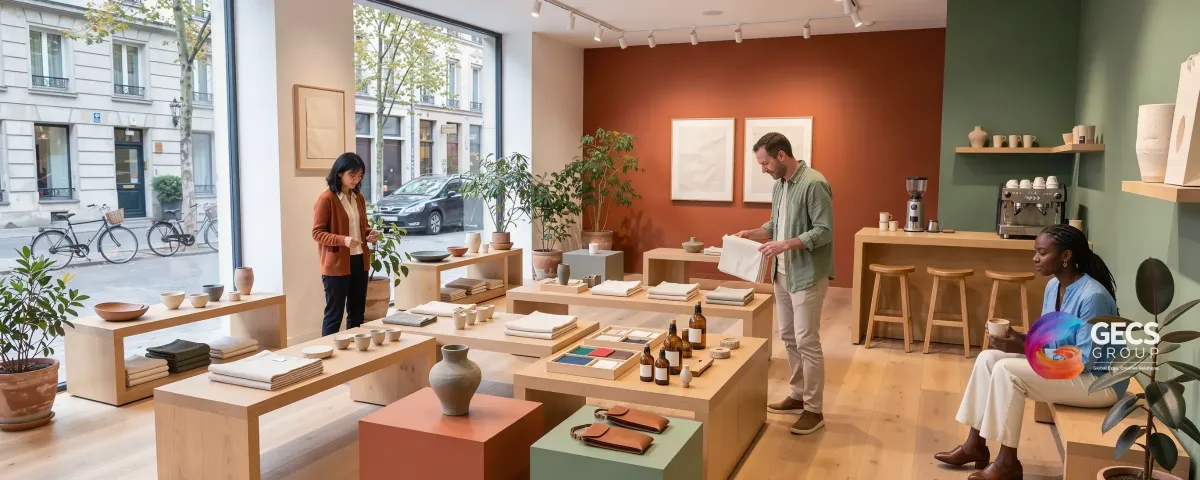
Retail design trends for 2027: experience, sustainability, modular fixtures, technology, lighting, colours and stores designed for online too.
The physical store hasn't disappeared: it has changed. In 2027 customers come into a store to try, touch, get advice, collect an online order or simply enjoy an experience. Retail design has to respond to all of this with spaces that are more flexible, more sustainable and more human.
Here are the trends we see in the projects we carry out for stores in Italy and Europe. For trade shows, read our exhibition stand trends for 2027 instead.
In short: fewer products on display and more experience, natural and recyclable materials, modular fixtures that move, discreet technology that serves the customer, designed lighting, warm colours and spaces for collecting online orders.
1. The store as an experience

The store becomes a place to visit: areas to try products, small events, workshops, consultations, a coffee corner. Less merchandise is displayed and it is presented better. The goal is not just to sell today, but to bring customers back and get them talking about the brand.
2. Sustainable, durable materials

Certified wood, recycled panels, low-emission paints, metals that can be dismantled and reused. Customers and brands want stores that last and that can be dismantled and recycled at the end of their life. The same rules apply as for sustainable exhibition stands.
3. Modular, flexible fixtures

| 📈 Trend | 💡 What it means | 🛠️ Advantage |
|---|---|---|
| 🎭Experiential store | Try-out areas, events, consultation | More time in store and loyalty |
| 🌱Sustainable materials | Certified wood, recycled, demountable | Image and end-of-life costs |
| 🧩Modular fixtures | Modules on wheels, reconfigurable fitted walls | A new layout without redoing the store |
| 📱Discreet technology | Screens, totems, mobile payments | Fast service and endless catalogue |
| 🔁Spaces for online | Order collection, returns, lockers | More visits and extra purchases |
Modules on wheels, modular tables, walls with slotted-rail systems: the store changes its look for each season or promotion without new building work.
4. Discreet technology

Screens built into furniture, touch-screen kiosks for the catalogue, payments from the sales assistant's phone, electronic shelf labels. Technology should disappear into the furniture and serve the customer, not distract them.
💬 Want to renew your store in line with 2027 trends? Send us photos and dimensions: we will propose an up-to-date, buildable design. Ask for a proposal →
5. Light, colour and omnichannel

Light is designed like a material: accents on products, atmospheres that change during the day. Colours move towards warm, natural tones, with bold brand accents. And the store connects with online: order collection points, fast returns, lockers, visible stockrooms. For lighting, read our guide to store lighting.
6. What following the trends costs

| 🎯 Intervention | 💶 Indicative cost | ⏱️ Timing |
|---|---|---|
| 🌱Sustainable materials instead of traditional ones | +0–15% | The same |
| 🧩Modular fixture system | +10–20% initially, savings on refits | 4–8 weeks |
| 📱Integrating screens and kiosks | €2,000–15,000 | 2–4 weeks |
| 🎭Experience or events area | €5,000–30,000 | 3–6 weeks |
Mistakes to avoid
- Chasing fashion without a strategy. A trend only helps if it helps you sell.
- Technology for its own sake. Screens that are off or useless worsen the image.
- Sustainability in name only. Customers notice.
- Fixed furniture everywhere. The store ages quickly.
- Forgetting the staff. The space must also help the people who work there.
The trends at a glance: impact and cost
Not every trend carries the same weight for every store. The table helps you see how much each affects the customer experience and how much it costs to introduce.
| 📈 Trend | 👥 Impact on customers | 💶 Indicative investment | 🎯 Who it suits |
|---|---|---|---|
| ✨Experiential store | High | Medium-high | Brands with products to try and explain |
| 🌿Sustainable materials | Medium, growing over time | Medium | Everyone, especially fashion, cosmetics, food |
| 🧩Modular fixtures | Medium | Low over time | Stores whose range changes often |
| 📱Discreet technology | Medium | Variable | Medium-large stores, chains |
| 💡Dynamic lighting | High | Medium | Fashion, furniture, luxury |
| 🔄Omnichannel | High | Medium | Those who also sell online |
The right choice always starts from your customers and your goals: a trend that does not meet a real need remains a cost.
The store as a community place
One of the most interesting developments is the store that becomes a meeting place. Bookshops with cafés and book launches, bike shops that organise group rides, cosmetics stores with small workshops, food shops with evening tastings: the sales space hosts activities that bring people in and create a bond with the brand. This requires flexible fixtures that can be moved or folded away to free up space, an area that can become a stage or a communal table, and adjustable sound and lighting.
The community store doesn't only sell during events: those who take part come back, recommend the store to friends and prefer it to online competitors. It is a particularly effective strategy for independent stores, which cannot compete on price with the big platforms but can offer relationships and expertise.
Real sustainability, not window dressing
Sustainability is now a widespread customer demand, but it has to be real. In retail design it translates into specific choices: FSC- or PEFC-certified, low-emission wood panels, water-based paints, recycled or recyclable materials such as metals, glass and some fabrics, low-energy LED lighting with control systems, and fixtures designed to last, be repaired and be dismantled. Choosing local manufacturers, which reduces transport, also counts. Communicating these choices with concrete data, such as the percentage of recycled material or the energy saved, makes the brand's commitment credible. Find out more in our guide to the sustainable stand, whose principles also apply to stores.
An example: renewing a store in line with 2027 trends
A 120 m² homeware store wants to refresh itself without an excessive investment. The design picks three trends consistent with the brand: modularity, with slotted-rail fitted walls and modular tables that allow the display to change every season; experience, with a demonstration kitchen at the back of the store where small cooking classes are held every Saturday; omnichannel, with an online order collection point near the till and QR codes on price tags to see variants not on display.
The materials are certified wood and painted metal, the lighting is LED with different scenes for daytime and evening events. The total cost is roughly €50,000–80,000, with the work done in three weeks. The store gains new customers thanks to the classes and increases sales of matching products presented in the demonstration kitchen.
The role of data in design
A less visible but increasingly important trend is the use of data to design and improve stores. People counters, till systems that record sales by product and position, maps of customer paths and simple observation on the shop floor show which areas work and which don't. Design no longer ends on opening day: you measure, correct, move a display, change a light. Modular fixtures make these corrections easy and cheap. For the basic principles, read our guide to visual merchandising.
Trending materials and finishes
Aesthetically, retail design in the coming years favours natural, tactile materials. Light wood, such as oak and ash, remains the star, often with matt finishes that show the grain. Textured surfaces, such as lime plaster, micro-cement, Venetian terrazzo and honed stone, add depth and a sense of craftsmanship. Metals are used sparingly, in brushed or burnished finishes, for profiles, bases and details. Fabrics, in fitting-room curtains, seating and sound-absorbing panels, bring softness and improve acoustics.
Colours are dominated by warm neutrals such as sand, clay, sage green and terracotta, with bolder brand accents. Real plants, where manageable, complete the environment and make it more welcoming. The overall effect is a calm, well-kept space that showcases products instead of competing with them.
Discreet technology: some examples
- Electronic shelf labels that update prices and promotions without changing tags by hand.
- Mobile tills on tablets or smartphones, which reduce queues and let customers pay anywhere in the store.
- Interactive mirrors and screens in fitting rooms or near products, to see variants and combinations.
- Collection points and lockers for online orders, accessible even outside opening hours.
- Sensors that count entries and measure flows, to improve layout and display.
The rule is that technology must make life easier for customers and staff. If it needs long explanations or breaks down often, it worsens the experience instead of improving it.
How to choose where to start
Anyone wanting to update their store can proceed step by step. The first step, almost always, is lighting: it costs relatively little and immediately changes how the space and products are perceived. The second is the order of the display, with more flexible fixtures that tell the story of the range better. The third is materials, to be renewed in the most visible spots, such as the window, the till and the main wall. More demanding interventions, such as a new layout or experiential areas, are planned after measuring the results of the first steps.
The role of Made in Italy
In a global market where many stores look alike, Italian craftsmanship and design are a distinguishing factor. Custom furniture made in Italy, with careful workmanship and chosen materials, makes it possible to create unique spaces, far from the “catalogue” effect of standard solutions. For international brands, a store with Made in Italy furniture communicates quality and attention to detail; for Italian stores, enhancing their own identity and territory is a concrete answer to uniformity. The retail design of the future is not just technology: it is also, perhaps above all, the ability to create spaces with a soul.
Accessibility and inclusion
Another trend that is consolidating is attention to inclusion. Stores accessible to people with motor, visual or cognitive disabilities, with clear routes, legible signage, lowered counters, spacious fitting rooms and trained staff, are not just a legal obligation: they widen the audience and improve everyone's experience, from older people to families with pushchairs. Opening hours with dimmed lights and music, dedicated to those who suffer from sensory overload, are also an increasingly appreciated sign of care.
Summary
Retail design in 2027 puts experience at the centre, along with real sustainability, flexible fixtures, technology that helps without intruding and strong integration between the physical store and online. You don't need to follow every trend: it pays to choose those consistent with your customers and brand, introduce them step by step and measure their effect.
Frequently asked questions
Quick answers to the questions we hear most often
Do the trends apply to small stores too?
Yes, on a smaller scale: a small store can focus on sustainable materials, careful lighting, flexible fixtures and a few events, without big technology investments.
How often should a store be renewed?
A complete refit every seven to ten years, with updates to lighting, graphics and display every one to three years, keeps the store current without excessive investment.
How can I tell if a trend suits my store?
Ask yourself whether it meets a real need of your customers and whether it fits your brand; if possible, try it in one area of the store before extending it.
Does the physical store still have a future?
Yes, but with a different role: no longer just a place to buy, but a space for experience, advice and relationships, integrated with the brand's online channels.
How much does a “light” store refresh cost?
Work on lighting, graphics and some key fixtures starts at roughly €150–300/m², far less than a complete refit.
What is the main retail design trend for 2027?
The store as an experience: less merchandise, more service, more reasons to come back.
Do sustainable fixtures cost more?
Often little or nothing more, and value is recovered at the end of their life.
Is it worth redoing the whole store?
Not always: modular fixtures and new lighting can renew the store on a limited budget.
Do you also design the store layout?
Yes, read the visual merchandising rules we apply in our projects.
Do you work throughout Italy and Europe?
Yes, we produce in Italy and install throughout Italy and Europe.

Want a store designed for 2027?
We design and produce custom furniture in Italy for modern, sustainable and modular stores, with turnkey installation.