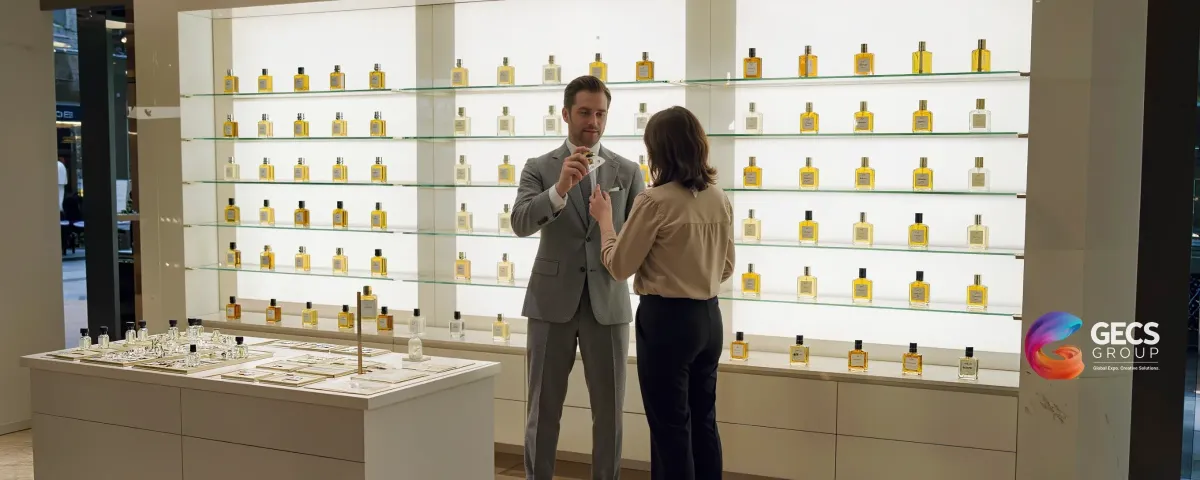
How to fit out a perfumery: layout, brand walls, tester islands, checkout counter, beauty cabin, lighting, materials and indicative costs.
In a perfumery customers buy with their senses: they look at the packaging, try fragrances, test a lipstick on their hand. The fit-out must make everything easy to find and try, showcase the most important brands and convey cleanliness and accessible luxury.
In this guide we look at layout, display walls, tester islands, counter, beauty cabin, lighting, materials and costs. For the general rules, read our guide to visual merchandising.
In short: perimeter walls divided by brand or category, central islands with testers within reach, a checkout counter with room for gift wrapping, a treatment cabin if services are offered, bright light with high colour rendering and easy-to-clean materials.
1. Shop layout

| 🧱 Area | 📏 Recommended floor share | 🎯 Function |
|---|---|---|
| 🌸Women's and men's fragrances | 35–40% | Brand walls, testers |
| 💄Make-up | 20–25% | Islands and units with mirrors |
| 🧴Skincare and body | 20–25% | Shelving and advice |
| 💆Beauty cabin and services | 10–15% | Treatments, make-up by appointment |
2. Display walls and brands

The big fragrance houses often ask for dedicated spaces with their own image: modular walls with glass shelves, backlighting and replaceable graphic panels let you change brand without redoing the shop. For brand spaces, read our guide to shop-in-shops and corners.
3. Tester and make-up islands

Central islands draw customers into the shop: tidy testers, mirrors, wipes, bins and front lighting to see the colour on the face. Worktops in solid surface or laminate resist perfume, alcohol and cosmetics and can be cleaned in seconds.
4. Checkout counter and gift wrapping

The checkout counter needs space to wrap gifts, drawers for ribbons and bags and an impulse-buy area: samples, miniatures, accessories. At Christmas and Valentine's Day it is the busiest point in the shop.
💬 Opening or renovating a perfumery? Send us the floor plan and the brands you stock: we will propose layout, displays and a custom counter. Ask for a proposal →
5. Lighting and materials

You need high colour rendering LEDs (CRI 90 or more), light built into the shelves to make bottles sparkle and neutral light on make-up mirrors. Typical materials: high-gloss lacquer, glass, brushed steel, brass, stone or solid surface.
6. Costs and timing

| 🛠️ Type of perfumery | 💶 Indicative cost | ⏱️ Timing |
|---|---|---|
| 🏪Small perfumery 40–60 m² | €30,000–60,000 | 5–7 weeks |
| 🏬Perfumery 80–150 m² | €60,000–140,000 | 6–9 weeks |
| ✨Premium perfumery with cabins | from €1,000/m² | 8–12 weeks |
| 🔁Renewal of walls and islands | €15,000–50,000 | 3–5 weeks |
Mistakes to avoid
- Testers hard to find or dirty. Customers don't try and don't buy.
- Yellow or cold light on mirrors. Make-up colours look wrong.
- Delicate materials. Alcohol and oils damage unprotected lacquer and wood.
- Counter too small. Gift wrapping creates queues.
- Fixed walls. Changing brand costs too much.
The areas of a modern perfumery
Today a perfumery offers fragrances, make-up, skincare, hair products and advice or beauty services. Organising the space into clear areas helps customers find their way and lets staff work better.
| 🧴 Area | 📦 What it contains | 📐 Design guidelines |
|---|---|---|
| 🌸Fragrances | Major brand and niche perfumes | Walls by brand, easily accessible testers, blotters and room to try |
| 💄Make-up | Make-up, accessories, seasonal launches | Islands with mirrors and front lighting, seats for trials |
| 🧖Skincare | Face and body treatments | Displays organised by need, advice area |
| 🧴Hair and body | Shampoos, treatments, hygiene | Self-service shelving, fast-moving products |
| 💆Services | Make-up, skin analysis, small treatments | Cabin or semi-private station, washbasin |
| 🎁Checkout and gifts | Payment, gift wrapping, small purchases | Large counter for wrapping, impulse display |
The most important brands often ask for dedicated spaces with their own displays, so the layout must reconcile the perfumery's identity with that of the brands it hosts.
An example: a 70 m² independent perfumery
A neighbourhood perfumery of 70 m² on a shopping street wants to stand out from the big chains by focusing on niche fragrances and advice. The design features light wood walls with backlit glass shelves for fragrances, organised by olfactory family rather than by brand; in the centre, a large stone table with new arrivals and testers, lit by pendant lights; a make-up station with an illuminated mirror and high stool near the window, clearly visible from the street. At the back, a small cabin for facial treatments.
The checkout counter, in wood and stone, has a large top for gift wrapping and a drawer for ribbons and papers. The lighting combines neutral, bright light on the displays with warm general light. The cost of furniture, lighting and installation is roughly between €50,000 and €80,000. The new fit-out immediately conveys an identity different from the chains and invites customers to stop and ask for advice.
Testers: the heart of the sale
In a perfumery, customers want to try. Testers must always be there, clean and easy to use, with enough room to spray without hitting other products and a holder for blotters. For make-up you need well-lit mirrors, wipes, disposable applicators and a waste bin within reach. Displays must allow empty testers to be replaced quickly and keep the boxes for sale, sealed and intact, separate — perhaps in drawers under the top. A good design reduces theft while keeping trial free: valuable products stay protected or close to staff, while testers are freely accessible.
Lighting and mirrors for make-up
Light is decisive in make-up areas. To judge a foundation or a lipstick you need light that faithfully renders skin tones: high colour rendering, at least CRI 90, and a neutral temperature of around 4000 K that simulates daylight. The light must reach the face from the front, from mirrors lit on the sides or with illuminated frames, avoiding shadows from above that age the features. Fragrance areas can instead have warmer, atmospheric light with accents on the bottles, which are often small design objects. Find out more in our guide to shop lighting.
Materials suitable for a perfumery
Perfumery furniture must be beautiful and durable at the same time. Testers leave drops of perfume, which contains alcohol and can damage delicate paints and lacquers; make-up stains; surfaces are cleaned many times a day. For tester tops, non-porous, chemical-resistant materials are therefore used, such as glass, solid surface, quartz and quality laminates; for walls, resistant lacquers or clad panels. Glass shelves show off bottles and are easy to clean; gold or brushed metal details add a touch of luxury. Find out more in our guide to solid surface.
The perfumery window
A perfumery window works mainly around the big occasions: Christmas, Valentine's Day, Mother's Day, summer. During these periods brands often supply promotional materials, but the best result comes from integrating them into your own display, consistent with the shop's image. A few well-lit products, a backdrop that changes with the seasons and a clear message, such as a gift idea or a new launch, work better than a window crammed with boxes. Perfume bottles, often designer pieces, take centre stage when displayed on risers of different heights with spotlights. Also read our guide to window display design.
The customer journey
Many customers enter a perfumery with a precise idea, such as their usual perfume or a product that has run out; others are looking for a gift or just browsing. The layout must serve both. Those who know what they want must find it quickly, thanks to clear signage and a logical organisation of the walls; those looking for inspiration must be encouraged to wander, with new-arrival islands, seasonal suggestions and trial stations along the way. Best-selling fragrances are usually placed at the back or on the sides, so customers cross the shop past the new arrivals; make-up near the window, where trials catch passers-by's eyes; the checkout in a central position, from which staff can oversee the whole space.
Advice and services: the space that builds loyalty
Advice is the perfumery's real advantage over online shopping. A station where customers can sit down calmly, try a treatment, get advice on their beauty routine or have their make-up done for a special occasion creates a personal relationship. Some perfumeries offer skin analysis with dedicated devices, make-up classes for small groups or cabin treatments. These services need suitable spaces: a cabin with a washbasin, good light, privacy and a quiet setting away from the sales flow. They are modest investments that bring loyal customers and repeat purchases.
Perfumery and online sales
Many perfumeries also sell online or via social media. The physical shop must integrate with these channels: a pick-up point for online orders, a well-lit space to photograph products and shoot short videos, screens or QR codes linking to product pages. In-store events, such as new fragrance launches or make-up days, are promoted on social media and bring people into the shop. Planning these activities into the design avoids having to improvise them in unsuitable spaces.
Indicative costs
| Element | Indicative price |
|---|---|
| ▸Backlit display wall (per linear metre) | €700–1,500 |
| ▸Tester island with mirrors and lights | €3,000–8,000 |
| ▸Make-up station with stool and illuminated mirror | €1,500–4,000 |
| ▸Checkout counter with wrapping area | €3,500–8,000 |
| ▸Complete fit-out (per m²) | €600–1,200 |
Indicative figures for furniture made in Italy, including lighting and installation, excluding brand-supplied displays and building works.
The most common mistakes
- Overfilled walls: hundreds of boxes in a row make choosing difficult and lower the perception of quality.
- Dirty or missing testers: customers don't try and often don't buy.
- Wrong light in the make-up area: distorted skin tones and unreliable trials.
- Uncoordinated brand displays: the shop looks like a collection of corners with no identity.
- Checkout counter too small: during holidays there is no room to wrap gifts.
- No seating: whoever accompanies the customer gets bored and hurries them out.
Summary
Fitting out a perfumery means organising clear areas for fragrances, make-up, skincare and services, making trials easy and pleasant, lighting products and faces correctly, choosing durable materials and integrating brand displays into a coherent image. For independent perfumeries, a custom fit-out is also the most effective way to stand out from the chains.
Frequently asked questions
Quick answers to the questions we hear most often
Do brands supply the displays?
Often yes, especially the big brands; but the perfumery must integrate them into its own furniture, with coordinated walls and bases that avoid a "collage" effect.
How much space does a make-up station need?
About 2–3 m², with a high stool, an illuminated mirror, a surface for products and room for the make-up artist working standing up.
Can a perfumery be renovated without closing?
Often yes, working area by area at night or on closing days; display walls made in the workshop can be installed in a few hours.
How can valuable products be protected from theft?
With locked cabinets for the most expensive boxes, testers kept separate from products for sale, anti-theft gates at the entrance and a checkout with a good view of the whole shop.
Is it better to arrange perfumes by brand or by olfactory family?
Chains arrange by brand, many niche perfumeries by olfactory family: the second approach encourages advice and the discovery of new fragrances.
How much does it cost to fit out a perfumery?
Roughly from €30,000 for a small perfumery to over €140,000 for a large or premium shop.
How long does it take?
From 5 to 12 weeks for design, production and installation.
Do you also build corners for cosmetics brands?
Yes, to the brand's design or designed by us following its guidelines.
Which materials do you recommend for tester tops?
Solid surface, HPL laminate or glass: they resist perfume, alcohol and cosmetics.
Do you work throughout Italy and Europe?
Yes, we produce in Italy and install throughout Italy and Europe.

Want a perfumery that makes people want to try and buy?
We design and produce in Italy furniture for perfumeries and cosmetics shops: display walls, tester islands, counters and cabins, with turnkey installation.