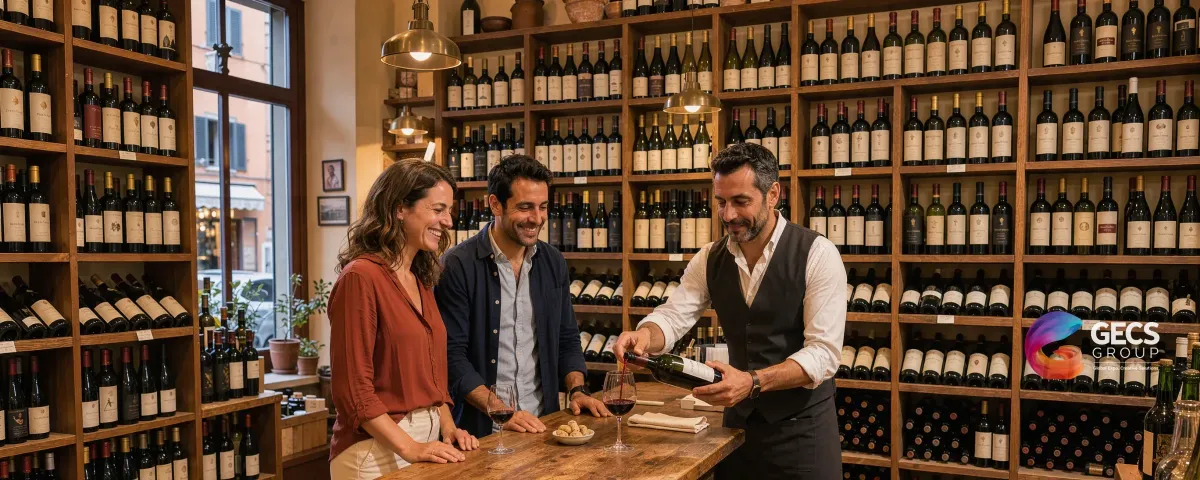
How to fit out a wine shop or wine bar: layout, bottle shelving, tasting counter, wine storage, lighting, lead times and costs.
A wine shop sells bottles, but above all it sells discovery and advice. The fit-out must display hundreds of labels in order, store them properly and invite customers to stop, ask and perhaps taste. If wine is also served by the glass, it becomes a wine bar and you need a counter, seating and service space.
In this guide we cover layout, shelving, tasting counter, storage, lighting, materials, lead times and costs. For the bar side, also read our guide to bar fit-out.
In short: walls of shelving for bottles arranged by region or type, a central counter for advice and tasting, a climate-controlled area for important wines and warm light that doesn’t heat the bottles. Wood remains the material of choice.
1. Wine shop layout

Bottles go on the walls, customers in the middle. A good scheme has shelving around the perimeter, a central island or table for new arrivals and promotions, a counter for advice and payment and, if possible, a small tasting area with stools. Aisles should be at least 90–120 cm wide so people can move among the bottles safely.
2. Bottle shelving

| 🍷 Type of shelving | 📏 Features | 🎯 Ideal for |
|---|---|---|
| 🪵Solid wood or oak | Warm, sturdy, classic | Traditional wine shops |
| 🔩Metal and wood | Light, modern, modular | Contemporary wine shops |
| 🧊Visible climate-controlled cabinet | Controlled temperature and humidity | Fine wines and champagne |
| 🗄️Drawer units and pigeonholes | Bottles lying down, one per slot | Prestigious labels |
| 🍾Case displays | Sloping shelves, sturdy bases | Promotions and wines in quantity |
Each full bottle weighs about 1.3–1.5 kg: a one-metre shelf holding 60 bottles exceeds 90 kg. That is why structures, shelves and wall fixings must be properly sized. Bottles to be kept for a long time should lie down; fast-selling ones can stand upright with the label clearly visible.
3. Counter and tasting area

The counter is the heart of the wine shop: this is where you give advice, open a bottle and wrap a gift. It needs space for the till, glasses and a small sink if wine is served. A tasting area with high tables and stools turns the visit into an experience and raises the average spend.
4. Wine storage

Wine fears heat, direct light and temperature swings. In the shop a stable temperature of around 16–18 °C is advisable and, for fine wines, a visible climate-controlled cellar behind glass, which also becomes a showpiece. Shelving should not stand near sun-exposed windows or heat sources.
💬 Opening a wine shop or wine bar? Send us the floor plan and photos: we will propose a layout, shelving and a custom counter. Ask for a proposal →
5. Lighting and materials

Light should be warm and soft, using LEDs that don’t heat the bottles. Adjustable spotlights highlight the labels, LED strips in the shelves create atmosphere. Wood, iron, stone, exposed brick and warm floors tell the story of the territory. For ideas on materials, read our guide to custom furniture for shops.
6. Lead times and costs

A wine shop is usually fitted out in 5–8 weeks. Indicative costs:
| 📐 Project | 💶 Indicative cost | ⏱️ Lead time |
|---|---|---|
| 🏪Wine shop 30–50 m², shelving and counter | €18,000–40,000 | 5–6 weeks |
| 🍷Wine bar 50–80 m² with service | €45,000–90,000 | 6–8 weeks |
| 🏛️Premium wine shop with visible cellar | from €1,000/m² | 8–10 weeks |
| 🧊Climate-controlled glass cellar | €8,000–25,000 | 4–6 weeks |
Mistakes to avoid
- Undersized shelving. The weight of the bottles is always higher than you think.
- Light that gives off heat. It damages the wine and labels.
- No logical order. Customers can’t find anything and don’t ask.
- Narrow aisles. Risk of knocks and broken bottles.
- Nowhere to taste. You miss the chance to let people try and sell more.
How to display bottles: systems compared
In a wine shop the choice of display system determines how many bottles can be shown, how customers see them and how they are stored. Each has advantages and limits.
| 🍷 System | 📦 Indicative capacity | ✅ Advantages | ⚠️ Limits |
|---|---|---|---|
| 🛌Bottles lying in pigeonholes | 80–120 per linear metre (2 m high) | Correct cork storage, high capacity | Label hard to see |
| 📐Sloping shelves with label facing out | 30–50 per linear metre | Label on view, easy choice | Reduced capacity |
| 🍾Bottles standing on shelves | 50–80 per linear metre | Shop feel, fast rotation | Not suitable for long storage |
| 📦Stacked wooden crates | Variable | Cellar atmosphere, flexible | Needs tidying, takes up floor space |
| ❄️Glass-fronted climate cabinets | 50–150 per cabinet | Controlled temperature for fine wines | Cost and power consumption |
A widely used solution combines one bottle standing or tilted with the label on view and, below or beside it, the others lying in pigeonholes: the customer sees the wine and the stock stays well stored.
An example: an 80 m² wine shop with wine bar
A neighbourhood wine shop wants to add wine by the glass and small plates, in an 80 m² space with a mezzanine. The design includes oak walls with pigeonholes for about 1,500 bottles, arranged by Italian region and foreign country, with handwritten labels. In the centre, a long communal table in solid wood for tastings; near the window, a few high tables with stools. The wood and stone counter holds a wine-by-the-glass dispenser that preserves open bottles, a small fridge for whites and sparkling wines and a display case for cured meats and cheese.
The mezzanine becomes a small room for guided tastings and private dinners. The lighting is warm, with spotlights on the bottle walls and pendant lamps over the table. Furniture, pigeonholes, counter and lighting cost roughly €60,000–95,000, excluding wine-service equipment and building work. The new format increases customers’ dwell time and sales of bottles to take home after tasting.
Tasting as an experience
Many wine shops organise tastings, courses and meetings with producers. To do this you need a suitable space: a large table or several tables that can be pushed together, comfortable seating, good white light on the table to observe the wine’s colour, a nearby sink for glasses, and a wall or screen to project maps and data sheets. Acoustics matter too: sound-absorbing ceiling materials or heavy curtains stop voices echoing when the room is full. A space designed for events turns the wine shop into a meeting point for enthusiasts, who become loyal customers.
Wine in the shop: temperature and light
Wine displayed in a shop isn’t stored as in a cellar, but a few rules help keep it in good condition. The temperature should stay stable, without big swings between day and night, ideally between 14 and 18 °C in the sales area; bottles must not be exposed to direct sun from the window or the heat of spotlights that are too close. LEDs, which produce little heat and no ultraviolet rays, are the best choice. For fine and age-worthy wines, a climate-controlled cabinet or a small cellar with temperature and humidity control, visible through a glass wall, is advisable and also becomes a showpiece.
The wine shop and online sales
Today many wine shops also sell online or offer home delivery. The physical shop remains the place for advice and discovery, but it must integrate a few functions: space to prepare and pack shipments, a collection point for online orders, and codes or QR codes on the labels to view wine sheets and buy later. Planning for these needs in the design avoids having to carve them out later in makeshift spaces that make the shop untidy.
Arranging wines: by region, style or price
How wines are arranged on the shelves strongly influences the customer experience. Arranging by region is the most classic approach and appeals to enthusiasts looking for a specific territory. Arranging by style, such as fresh whites, full-bodied reds, sparkling or sweet wines, helps those who don’t know wine well and are looking for something for an occasion. Arranging by price band is useful for gifts and for those with a set budget. Many wine shops combine criteria: walls by region and a central island with suggestions by occasion, the month’s picks and gift ideas.
Whatever the choice, signage must be clear and consistent with the shop’s style: chalkboards, wooden tags and small cards with food pairings and tasting notes make choosing easier and invite customers to ask for advice.
Wine corners in shops and supermarkets
The same rules apply to wine corners inside food shops, delicatessens and supermarkets. Here space is limited and customers often choose on their own: it pays to use wooden shelving that sets the area apart from the rest of the shop, good warm lighting, tags with short descriptions and pairings, and a display for bottles on promotion or for gifts. A small fridge for chilled whites and sparkling wines boosts sales, especially in summer and on holidays.
How much does a wine shop fit-out cost
As an order of magnitude, custom wooden pigeonholes cost €400–1,000 per linear metre depending on materials, height and finish; a sales and tasting counter €4,000–12,000; climate-controlled cabinets €2,000–8,000 each. For a complete 60–100 m² wine shop, the fit-out often comes to €500–1,000/m², excluding wine-service equipment. For other benchmarks, read our guide on how much a shop fit-out costs.
The wine shop window
The wine shop window has a difficult job: catching attention without damaging the wine with sunlight. The solution is to display empty or display-only bottles, changing them often, and keep the bottles for sale inside. The window can tell a story: a region of the month, a guest producer, sparkling wines for the holidays, summer rosés. Wooden crates, corks, glasses, grapes and small objects linked to the territory create a simple, effective display. Discreet window graphics with the tasting calendar invite passers-by to come back.
In summary
A well-fitted wine shop displays many bottles in a tidy, legible way, stores them away from light and heat, offers space for tasting and advice, and creates a warm atmosphere that invites people to stay. With custom wooden furniture and carefully designed lighting, the shop becomes a meeting place for enthusiasts and a point of reference for anyone looking for the right wine.
Frequently asked questions
Quick answers to the questions we hear most often
What wood should be used for pigeonholes?
Stable, moisture-resistant woods such as oak, chestnut or treated fir; for a modern look, painted metal and wood-and-iron combinations are also used.
How deep should a pigeonhole unit be?
For 0.75-litre bottles lying down you need about 30–35 cm; for magnums and special formats, it is worth planning a few larger slots.
Can a wine shop be fitted out quickly?
With modular pigeonholes made in the workshop, installation takes a few days; however, design and production take four to six weeks.
Does the counter need a sink?
If wine is served by the glass, yes: you need a sink or glass washer near the counter, with hot and cold water, to comply with hygiene rules.
Wooden or metal shelving?
Wood creates a warm, traditional atmosphere, metal a modern, light look; many wine shops combine them, with metal frames and wooden shelves or pigeonholes.
How much does it cost to fit out a wine shop?
Roughly from €18,000 for a small shop up to more than €1,000/m² for a premium wine shop with a visible cellar.
How many bottles fit on one metre of shelving?
It depends on the system: usually 50–120 bottles per linear metre at full height.
Is a climate-controlled cellar needed?
For fine wines, yes; for fast-moving wines a cool, stable environment is enough.
Do you also build wine corners in supermarkets and food shops?
Yes, also read our guide to grocery store fit-out.
Do you work all over Italy?
Yes, we manufacture in Italy and install throughout Italy and Europe.

Want a custom wine shop fit-out?
We design and manufacture in Italy wine shelving, tasting counters and visible cellars, with turnkey installation.