How a shop is fitted out in Venice and Mestre: design, custom furniture, transport by boat and by hand, historic-centre rules, building services, timing and prices.
Fitting out a shop in Venice is not like doing it in any other city. Vans cannot reach the historic centre: furniture travels by boat, is unloaded on the quaysides and crosses bridges and narrow streets on hand trolleys. Buildings are old, often listed, with brick walls, timber beams and floors that must be protected. In Mestre and on the mainland, by contrast, most work takes place in shopping centres and busy streets, with different rules and timing.
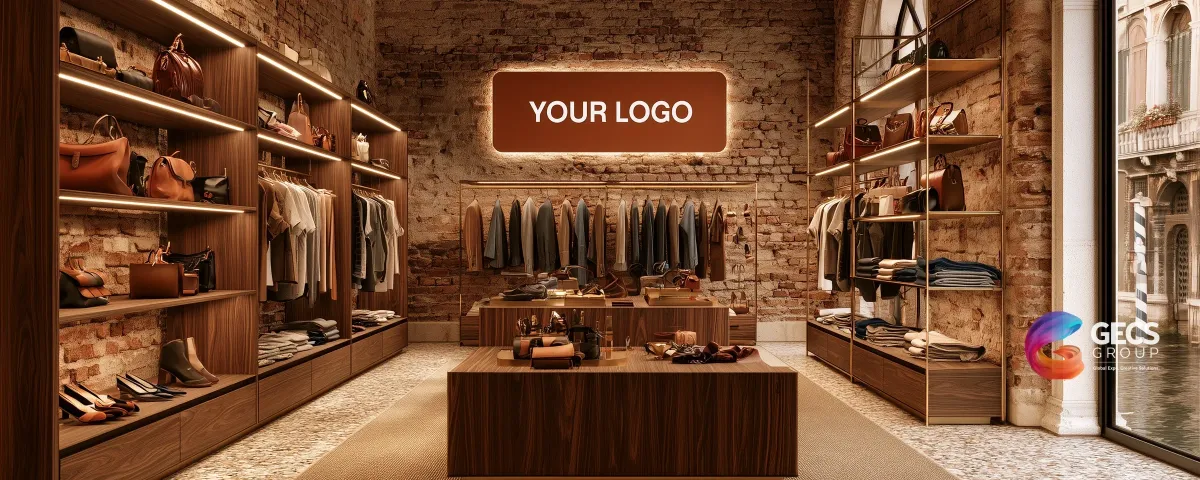
Our workshop is in Padua, about half an hour from Mestre: we design, manufacture and install custom furniture for shops throughout the province of Venice. In this guide we look at how shop fitting in Venice and Mestre works: design, logistics, restrictions, building services, timing and prices. The photos in this article are illustrations: they show how your shop could look after the works, with your brand in place of the words “YOUR LOGO”.
In short: in Venice furniture must be designed in modules that fit through narrow doors and over bridges, transported by boat and installed carefully in historic buildings; in Mestre you work with shopping-centre regulations and night shifts. A turnkey fit-out starts at about €350/m², €700/m² for a mid level and €1,250/m² for a premium shop (VAT excluded), with a package price locked by the contract and logistics included.
1. The finished shop in the historic centre

In the historic centre the shop interacts with the building: exposed brick, arches, Venetian terrazzo floors, windows over the canals. Custom furniture in wood, brass or metal enhances these surfaces instead of hiding them, and LED lighting highlights the products without touching walls and ceilings where that is not allowed. Boutiques, jewellers, art-glass shops, perfumeries and quality souvenir shops need well-kept windows and an image consistent with the brand. See the guide to boutique fit-out.
2. Boat deliveries and transport by hand

In Venice logistics are part of the project. Furniture leaves our Padua workshop by van to Tronchetto or Piazzale Roma, is then loaded onto a transport boat and delivered as close as possible to the shop. Each module is wrapped in protective film with corner guards, numbered and ready to be installed in the right order.

From the quayside to the shop the pieces travel on hand trolleys, including stair-climbers for the bridges. That is why we design furniture in modules that fit through narrow doors and streets and are assembled on site without losing quality. We organise access, loading times and permits to occupy the quaysides.
| 🗺️ Area | 🚚 How the furniture arrives | ⚠️ What to consider |
|---|---|---|
| 🛶Historic centre | Van + boat + hand trolley | Small modules, tides, loading times |
| 🌉Islands (Lido, Murano, Burano) | Boat or ferry | Ferry times, load weight |
| 🏬Mestre, shopping centres | Van to the back of the shop | Centre regulations, night works |
| 🛣️Mainland and province | Direct van | Parking and site access |
3. Shops in Mestre and in shopping centres

In Mestre and on the mainland many shops are in shopping centres or on busy streets. What matters here is a bright, readable image, windows that change often, modular shelving, a practical cash desk and comfortable fitting rooms for clothing. Shopping centres have technical regulations and a technical office that approves the project: we prepare drawings, material data sheets and certificates. Installation is often done at night or when the centre is closed. See the guide to fitting out a clothing store.
4. Working in historic buildings

In the historic buildings of central Venice every intervention needs careful thought. Brick walls, beams, decorated ceilings and old floors are protected during the works; furniture is fixed only where permitted, often on free-standing structures. Damp and high water call for suitable materials, furniture raised off the floor and services placed high up. Listed buildings, signs and shop windows need the approval of the heritage authority and the municipality: we prepare the documentation with your surveyor. See the guide to signs and permits.
5. Custom furniture from our Padua workshop

Counters, shelving, display cases, fitted walls and cladding are made in our Padua workshop in wood, laminates, metal, glass and solid surface. Producing nearby means quick surveys, sample checks in the workshop and deliveries scheduled to the day. For materials see the guide to custom shop furniture in Padua.
💬 Opening or refurbishing a shop in Venice, Mestre or the province? Send us address and floor area: we will survey the premises, organise the logistics and propose a 3D project and quote. Request a quote →
6. Turnkey works: refurbishment and building services
Besides the furniture, we carry out the works on the shop ourselves: refurbishment (demolition, plasterboard, false ceilings, floors), painting, electrical installation for lighting, windows, sign and till, and plumbing where water points or toilets are needed. We carry out the building services under our DM 37/08 qualification and issue the declaration of conformity at the end of the works. In the historic centre we coordinate the works with permitted hours and with the neighbours.
| 📅 Phase | ⏱️ Indicative duration | 📌 What happens |
|---|---|---|
| 🖥️Survey and 3D project | 1–2 weeks | Measurements, access, renders, itemised quote |
| 🏭Furniture production | 3–5 weeks | Modular furniture in our Padua workshop |
| 🧱Works on the shop | 1–3 weeks | Services, floors, painting |
| 🔧Transport and installation | 3–7 days | Boat or van, installation, lighting, sign |
For details see our services for building works for shops, electrical systems and lighting and plumbing. For a nearby example see shop fitting in Padua.
7. Sign and shop window in a calle

In a narrow calle the sign and shop window must catch the eye from a few metres away. In Venice signs follow precise rules on size, materials and lighting: painted wooden panels, brass letters or discreet window graphics are common choices. A well-lit, tidy shop window is worth as much as a large sign. See the guide to building shop windows.
8. How much does it cost to fit out a shop in Venice or Mestre
The price depends on floor area, type of shop, materials and accessibility of the premises. Indicative values for a turnkey fit-out, VAT excluded:
| 🏷️ Level | 💶 Indicative price | 📦 What it includes |
|---|---|---|
| 🟢Basic | from €350/m² | Modular shelving, cash desk, lighting, painting |
| 🟡Mid | from €700/m² | Custom furniture, display cases, sign, services |
| 🟣Premium | from €1,250/m² | Fine woods, brass, lit display cases, brand design |
We work with a package price, all inclusive: design, production, transport (including by boat), installation and crew travel. The figure is agreed once and written into the contract: if transport needs an extra trip or installation an extra day, the difference is on us. The price is locked by the contract. For a wider comparison see how much it costs to fit out a shop.
Work schedule in the historic centre
In Venice the timing of a shop fit-out depends not only on furniture production but also on transport organisation and the city’s rules. Boat deliveries must be booked, loading and unloading times are limited, and some areas have narrow passages, bridges and steps that force us to split furniture into smaller modules. That is why we prepare a detailed schedule: survey, design, production in our Padua workshop, transport to the mainland, transfer to the boat and installation. Each phase has a date and a person in charge, so the shop owner always knows where the work stands.
Before starting it is always useful to check with the Municipality and, if the building is listed, with the heritage authority (Soprintendenza) which works are allowed on the facade, sign and shop window. Permits often take longer than production: starting the paperwork at the beginning avoids having the furniture ready and the shop still closed.
Materials that resist humidity and salt air
The air in Venice is humid and salty, and at certain times of year high water (acqua alta) can reach the ground floor of shops. The furniture must be designed for this environment: water-repellent panels, sealed edges, adjustable feet in plastic or stainless steel that lift the unit off the floor, hardware that does not rust. In the most exposed areas we can design raised bases or removable plinths, which make it possible to clean and dry quickly after a high-water event.
- Humidity-resistant panels and edges, including the hidden parts.
- Hardware and feet in stainless steel or materials that do not oxidise.
- Electrical system with sockets and panels placed high, away from the floor.
- Raised bases and removable plinths in the areas most at risk.
Coordination with the building and neighbours
Many shops in the historic centre are on the ground floor of residential buildings. Before starting work it is wise to inform the building manager and the neighbours, agree on the times for the noisiest jobs and organise temporary storage of materials. With ready-made furniture produced in Padua and only assembled on site, the days of noise and dust in the shop are much fewer than with a traditional building site.
Shop windows and signs in a unique setting
In Venice every shop window interacts with calli, campi and canals that tourists photograph every day. A sign that is too large or too bright clashes with the surroundings and is often not even allowed; that is why we work with materials such as brass, painted wood, individual letters and discreet lighting, in line with the Municipality’s guidelines. The window, on the other hand, must be designed for people walking a few centimetres from the glass: products at eye level, a few well-lit elements and a display that is easy to change with the seasons and the city’s events, such as the Biennale or Carnival. Window bases can be raised and protected from humidity, so the display stays tidy even in the most difficult months and the shop looks well cared for all year round.
Why rely on a single team
Working in Venice with several different suppliers means coordinating transport, times, boats and permits for each of them. With a single team that produces the furniture, organises transport, installs and also handles building and system works, the shop owner has one contact person and one schedule. Unexpected problems, which are never lacking in the historic centre, are solved within the team without passing responsibility back and forth, and the price stays as agreed in the contract.
For shops in Mestre and on the mainland the logistics are simpler, but the method is the same: a clear project, a shared schedule and a price that does not change during the works.
Mistakes to avoid
- Furniture in one piece. In the historic centre it will not pass through doors, calli and bridges.
- Forgetting high water. Furniture flush with the floor and low sockets are damaged by the first tide.
- A sign without a permit. In the historic centre the municipality can order its removal.
- Ignoring shopping-centre regulations. The project must be approved before the furniture is produced.
- Improvised logistics. Boat, times and route must be organised before installation.
Frequently asked questions
Quick answers to the questions we hear most often
Do you also work on the islands, such as Murano or the Lido?
Yes, we organise transport by boat or ferry and install furniture on the islands too.
How long does it take to fit out a shop in Venice?
Usually 5–8 weeks from project to opening; installation in the shop takes 3–7 days.
Do you handle permits for signs and shop windows?
We prepare drawings and documentation and coordinate them with your surveyor for the municipality and the heritage authority.
Do you also do refurbishment and building services?
Yes, we carry out refurbishment, painting, electrical and plumbing work with a DM 37/08 declaration of conformity.
Is boat transport charged separately?
No, it is included in the package price, which is locked by the contract.
Are the photos your projects?
No, they are illustrations showing how a shop could look after the works. Our real projects are in the portfolio.
Want to fit out your shop in Venice or Mestre?
Custom furniture made in our Padua workshop, half an hour from Mestre, transport by boat and by hand in the historic centre, refurbishment and certified building services: one point of contact and a package price locked by the contract.