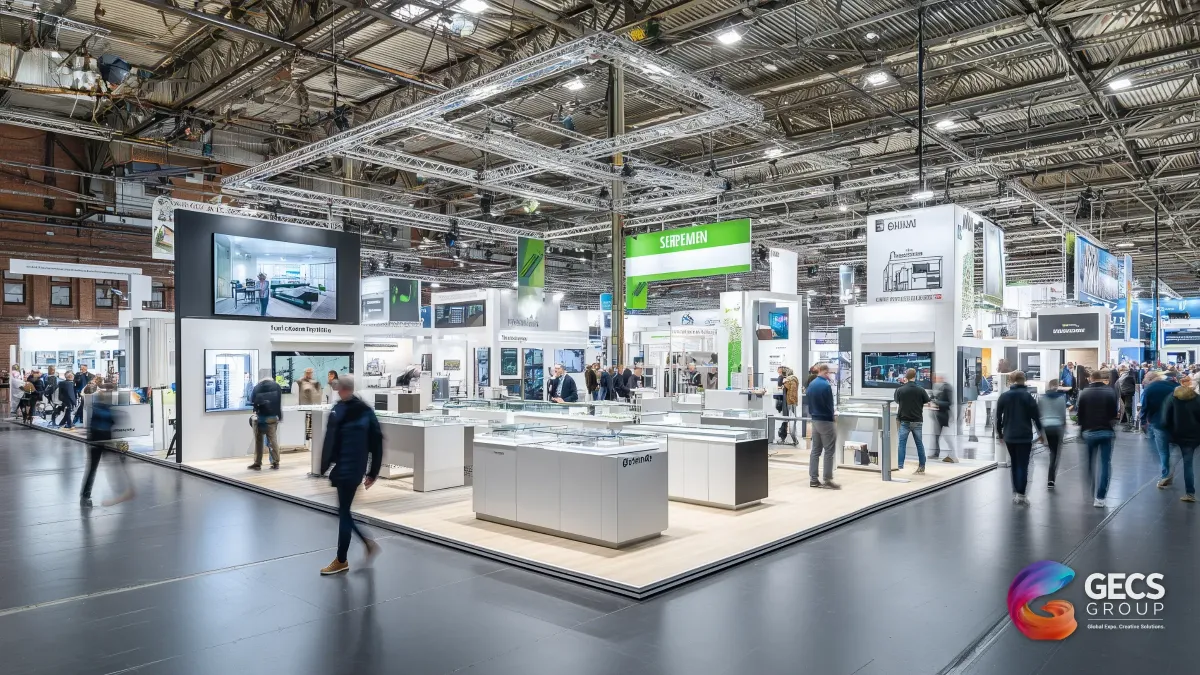
Open, closed or semi-open stand: advantages, disadvantages, meeting rooms, storage and how to choose based on your trade fair goals.
One of the first questions when designing a stand is whether to make it open or closed. An open stand invites people in, is visible from all sides and collects more leads; a closed stand creates exclusivity, protects products and conversations and filters visitors. In between there is the semi-open stand, which today is the most common choice at B2B fairs.
The decision is not a matter of taste: it changes the number of visitors, the type of contacts, the budget and even the rules you have to follow, because many fairs limit solid walls facing the aisles. In this guide we look at the differences, the advantages and disadvantages of each solution, the most common technical rules, how to manage visitor flows, meetings, storage and security, how much it costs and how to choose based on your goals. For stand positions in the hall, also read the guide on corner, peninsula, island and inline stands.
In short: choose an open stand if you want many leads, demonstrations and products people can touch; a closed stand if you sell high-value products, hold confidential negotiations or want an exclusive image; a semi-open stand to get both. Always check the fair regulation: often at least 20% of the open sides must stay open or transparent.
1. Open sides: the basis of the choice
Even before style, what matters is how many sides of the stand face the aisles. More open sides mean more possible entrances and more visibility, but also fewer walls for graphics, shelves and storage.
| 📍 Position | ↔️ Open sides | 📏 Typical sizes |
|---|---|---|
| ➖Inline (in a row) | 1 | 3×3 or 3×6 m |
| 📐Corner | 2 | 3×3 or 6×6 m |
| 🔲Peninsula (end of row) | 3 | 6×6 or 9×9 m |
| 🏝️Island | 4 | from 9×9 m upwards |
An inline stand has only one open side: it can be open towards the aisle, but it is inevitably partly “closed” by the neighbours’ walls. An island stand, on the other hand, can be completely open, completely closed or anything in between.
2. Open stand: more visitors, more leads

An open stand has few walls, no barrier at the entrance and a clear view from the aisle. Visitors walk in without feeling they are “inside a shop”, immediately see products and people and can leave just as easily. This is why it generates more footfall and more contacts, including casual ones.
It is the ideal solution for products to touch and try, live demonstrations, product launches, companies looking for new clients and fairs with large crowds. It also works well for young brands that want to communicate transparency and accessibility.
- Advantages: more traffic, welcoming atmosphere, products visible from a distance, structural costs often lower.
- Disadvantages: less privacy for negotiations, products less protected, harder to filter out uninterested visitors, you still need a hidden space for stock and personal belongings.
3. Closed stand: exclusivity and confidentiality

A closed stand has high walls on all or almost all sides and one or two controlled entrances, often with a host or hostess. Those who enter have chosen to do so, and the staff can give them time and attention. From the outside the stand looks like a compact, mysterious volume that sparks curiosity.
It is the typical choice for jewellery and watchmaking, luxury fashion, technology companies with confidential prototypes and businesses that only work by appointment with existing clients and distributors.
- Advantages: exclusivity, security of products and documents, confidential negotiations, large outer surfaces for graphics.
- Disadvantages: less footfall, risk of looking distant or “closed off”, higher costs for walls, doors and ceilings, possible regulation limits on solid walls.
4. The semi-open solution

Most professional stands today are semi-open: an open front with products, reception and demonstrations, and a closed area at the back with a meeting room, office and storage. Visitors enter easily, important clients find privacy and staff have a space to work.
| 🏷️ Type | 👍 Advantages | 👎 Disadvantages |
|---|---|---|
| 🔓Open | More visitors, welcoming effect, visible products | Less privacy, products less protected |
| 🔒Closed | Exclusivity, security, confidential negotiations | Less footfall, can look distant, costs more |
| 🌗Semi-open | Balance between leads and privacy | Needs more floor area and careful design |
A good starting rule: at least 60% of the floor area open and accessible, the rest dedicated to meetings and services. On small stands, under 20 m², the closed part shrinks to a 2–3 m² storage room.
5. Fair rules on walls and transparency

Many fair organisers limit solid walls facing the aisles, so as not to create “walls” along visitor routes. The Salone del Mobile in Milan, for example, requires entrances and transparent parts to make up at least 20% of the open sides, allows walls only 3 or 5 metres high and requires walls facing neighbouring stands to be finished in white.
Other common rules cover maximum height, closed ceilings (which may require smoke detection or sprinkler systems), distances from boundaries and graphics facing neighbours. So before deciding to close the stand, it is worth reading the technical regulation of the current edition. For wall materials, read the guide to walls, flooring and carpet.
6. Graphics and communication: what changes
Open or closed also changes the way you communicate. A closed stand offers large outer surfaces: they are perfect for a strong message, a large logo and a striking image, visible from 20–30 metres. But a wall full of graphics with no openings risks looking like a billboard: it is better to alternate graphic surfaces, display windows and openings.
An open stand has fewer walls, so the message must go up high, with a hanging sign or a totem, and into the products themselves. The brand must be readable from 10–15 metres and the main products should be displayed between 90 and 160 cm high, where the eye naturally falls. The same rule applies to both types of stand: one main message, few words, no product lists on the outer walls.
Lighting also works differently. A closed stand can create its own atmosphere, more intimate and theatrical, because it does not depend on the hall lighting. An open stand, instead, has to “beat” the general lighting of the fair with stronger spotlights on the products. To find out more, read the guide to stand colours.
7. Entrances and visitor flows

Even the most open stand needs rules to guide visitors. A raised floor or a carpet in a different colour marks the boundary with the aisle. A desk or totem near the entrance welcomes and directs people. The main products face the aisle, those that need more explanation are further inside.
- Wide entrances: at least 2–3 m, without steps or with a ramp, so as not to put off passers-by.
- Clear route: visitors must understand within a few seconds where to go and who to talk to.
- Staff standing up: staff sitting behind the counter are the number one reason people do not come in.
- Hot and cold zones: the most visible corner hosts the new product; the less visible areas host meetings and services.
8. Meeting rooms and acoustics

A private meeting room is used for negotiations, signing contracts and meetings with key clients. 6–10 m² is enough for a table and four chairs; 12–15 m² for a table for six. Walls in frosted glass or with film give privacy without closing off the space too much and let people glimpse that the stand is lively.
Background noise at a fair often exceeds 70 decibels. To make conversations pleasant you need a ceiling or false ceiling, sound-absorbing panels, carpet and a door that closes. If the stand is open, you can create a quieter meeting corner on the least exposed side, with fabric walls and plants.
9. Storage, security and valuables

Every stand, open or closed, needs a small storage room: brochures, stock, samples, coats, bags, a fridge, a coffee machine. Usually 2–4 m² hidden behind a wall, with a discreet lockable door, is enough.
On open stands, product security must be planned in advance: lockable display cases for small, expensive items, anti-theft cables for electronic devices, and one person in charge who always stays on the stand. Outside opening hours many fairs offer paid surveillance; for valuable products, specific insurance is a good idea.
10. How to choose: decide based on your goal
| 🎯 Goal | ✅ Recommended choice |
|---|---|
| 📇Collect many new leads | Open |
| 💎Present luxury or high-value products | Closed or semi-open |
| 🤝Negotiations with existing clients | Semi-open with meeting room |
| 🚀Launch of a new product | Open with demonstration area |
| 📅Meetings by appointment only | Closed with controlled entrance |
| 📏Small stand (9–16 m²) | Open with mini storage room |
Other factors to consider: the fair audience (trade visitors or general public), the number of staff, the budget and the floor area. With only a few square metres, closing the stand almost always means wasting valuable space.
11. Three practical examples
Machinery company, 120 m² island stand. The front is completely open, with two working machines and a screen for demonstrations. At the back, a 15 m² meeting room and a 6 m² storage room. Result: lots of traffic around the machines and calm negotiations with distributors, without losing visibility.
Jewellery brand, 36 m² peninsula stand. High walls on three sides with large illuminated display windows facing the aisle, a single entrance with a hostess and three private tables inside. Passers-by see the finest pieces in the windows; those who come in are interested buyers. The display windows act as “windows” and meet the rule on transparent parts.
Tech start-up, 16 m² corner stand. Completely open, with a demo counter on the most visible side, a totem for collecting leads and a lockable cabinet for backpacks and stock. No meeting room: important meetings take place at the fair bar or by appointment.
12. Open or closed depending on the floor area
The floor area makes a big difference to what is possible. Under 16 m² the stand should almost always be open: every extra wall takes away space and visibility. Between 20 and 50 m² you can create a small private area, separated by a wall or a curtain. Above 50 m² the semi-open stand becomes the most effective solution, and above 100 m² you can also consider several meeting rooms or a second floor for meetings.
The type of fair matters too. At fairs with a large general public, a closed stand filters out the curious and protects the staff’s work. At highly specialised B2B fairs, where almost all visitors are trade professionals, an open stand causes no problems and multiplies useful contacts.
13. How much it costs: open, closed and semi-open
| 🧾 Item | 💶 Indicative cost |
|---|---|
| 🔓Custom open stand | from €300 to €600 per m² |
| 🌗Semi-open stand with meeting room | from €400 to €750 per m² |
| 🔒Closed stand with ceiling | from €500 to €900 per m² |
| 🪟Frosted glass meeting room | from €2,500 to €6,000 |
| 📦Lockable storage room of 2–4 m² | from €600 to €1,500 |
A closed stand costs more because of the high walls, doors, ceilings and often ventilation systems. For other costs, read how much an exhibition stand costs.
💬 Not sure whether to open or close your stand? Tell us your goals and floor area: we will propose the right layout for free. Request a proposal →
14. The most common mistakes
- A closed stand for no reason. You lose visitors with no benefit.
- An open stand without storage. Boxes, coats and cups end up in plain sight.
- Unclear entrance. Visitors do not understand where to go in and walk on by.
- Solid walls facing the aisle. The stand cannot be seen and may break the regulation.
- Noisy meeting room. Without a ceiling and sound-absorbing materials, you cannot hold a conversation.
- No control over valuable products. On open stands, theft is easier.
Frequently asked questions
Quick answers to the questions we hear most often
Does a closed stand cost more?
Usually yes, by 20–40%: more walls, doors, ceilings and often more technical systems.
Are there limits on wall height?
Yes, every fair sets them in its technical regulation, often 2.5–5 m, with different rules towards the aisles and towards neighbours.
Can a small stand have a meeting room?
Under 20 m² it is difficult: a small table in a quiet corner and a small storage room are better.
How do you make a closed stand welcoming?
With a wide, bright entrance, display windows facing the aisle, a hostess at the entrance and a preview of the products visible from outside.
Do the walls facing the neighbours have to be decorated?
The regulation often requires them to be finished neutrally, for example in white, and forbids graphics facing neighbouring stands.
Do you design custom semi-open stands?
Yes, it is the solution we propose most often. Also read the guide to stand design.
Want a stand designed around your goals?
We design open, closed and semi-open stands, manufacture them in Italy and install them across Europe.