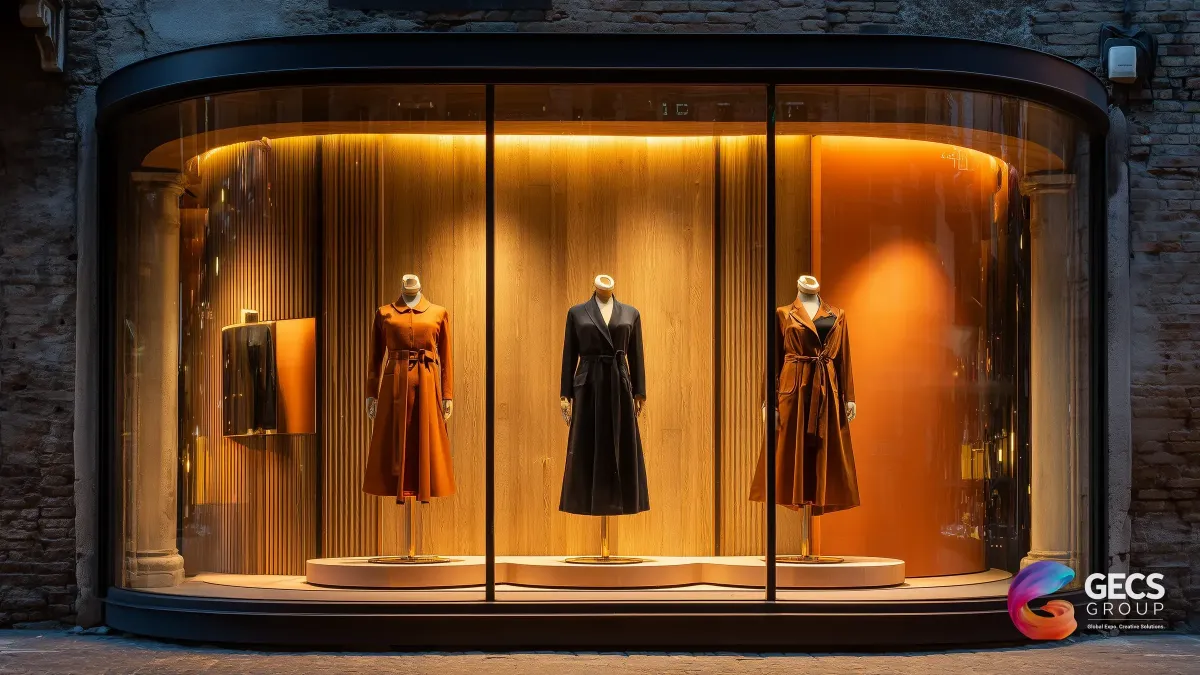
Window types, themes, composition, lighting, custom props, ideas by sector, 2026 trends and costs: a practical guide to a shop window that brings customers in.
The shop window is the store's first salesperson: it works even when you are closed and speaks to everyone who walks by. A good shop window display turns passers-by into visitors. A cluttered, dark or never-changing window, on the other hand, makes even the right customers keep walking.
In this guide you will find how to design an effective window: the types of window, how to choose a theme, composition rules, lighting, materials, ideas by sector, 2026 trends, costs and mistakes to avoid. If you are fitting out the whole store, also read our guide to shop fitting.
In short: a window has a few seconds to get noticed; one message at a time works better than ten products; light matters as much as merchandise; custom, reusable props lower costs over time; the window should change at least every season.
1. Why the window decides whether customers come in
People walking down the street look at a window for just a few seconds. In that time they need to understand what you sell, who you are for and why they should come in right now. The window therefore works on three levels:
- catching the eye with one strong element: colour, light, movement or an unexpected shape;
- communicating the store's identity: price range, style, type of customer;
- giving a reason to come in: something new, a collection, an offer, an event.
For many neighbourhood and town-centre shops, the window is also the only form of daily advertising. That is why it deserves a budget and planning, not just a quick tidy-up on Saturday morning.
2. Types of shop window

Before thinking about ideas, look at how your window is built. Its structure changes how it should be dressed:
- Closed window: it has a backdrop that separates it from the store. It is a small stage, perfect for scenery and seasonal themes.
- Open window: it lets people see into the store. The window and the first part of the sales floor have to work together.
- Semi-open window: a panel or screen covers only part of the view. A good compromise between stage and transparency.
- Corner window: visible from two streets. It needs a composition that reads from both sides.
- Island window or display box: typical of shopping centres and arcades, seen from several sides and often lit all round.
Measure the usable depth, height and width, check power sockets and light points, and see where the sun comes from: these are the starting data for any window design.
3. One theme, one message
The most common mistake is putting everything in the store into the window. An effective window tells one story at a time: the new collection, a colour, an occasion such as Valentine's Day or back to school, a flagship product.
To choose the theme, start from three questions:
- what do I want to sell over the next few weeks;
- what emotion or situation makes it desirable;
- which scenic element makes it visible from a distance.
The theme drives colours, materials, props and copy. If an element does not serve the story, it stays out.
4. Composition: how to arrange products and props

A window is read like a picture. A few composition rules help guide the eye:
- Focal point: one main element, larger or brighter, at eye level or slightly right of centre.
- Pyramid: products arranged at increasing height towards the centre, with the most important piece on top.
- Repetition: the same product or colour repeated in a row creates rhythm and visual impact.
- Rule of thirds: divide the window into thirds horizontally and vertically and place key elements where the lines cross.
- Empty space: leaving room around products makes them look more valuable.
Use different levels: podiums, cubes, floating shelves and mannequins keep everything from sitting on the window floor. Prices, if shown, should be readable but discreet.
5. Window lighting

By day the window fights reflections on the glass; in the evening it is often the only light on the street. That is why its lighting should be designed separately from the rest of the store:
- the window should be brighter than the interior, so the glass reflects less and the scene is easier to see;
- adjustable spotlights on a track let you shift the accent with every new display;
- LED strips hidden in podiums and shelves lift products off the background;
- high colour rendering (CRI 90 or above) shows the true colours of fabrics, cosmetics and food;
- a timer keeps the window lit in the evening, when many people pass by, at low cost thanks to LED.
6. Materials and custom props

Props make the difference between a tidy window and one people remember. Shaped panels, printed backdrops, podiums, frames, displays and suspended structures can all be made to measure for the exact space of your window.
It pays to design them modular and reusable: a lacquered wooden podium or a panel with interchangeable graphics can be used for several seasons by changing only the colour, print or accessories. That spreads the cost over many displays and cuts waste. At GECS Group we make these props in our own workshop in Italy, along with shop furniture and exhibition stands.
7. Seasonal windows and calendar

A window that never changes becomes invisible: people who pass every day stop looking. Plan a window calendar for the year, with at least one change per season and special displays for peak moments:
| 📅 Period | 🎉 Occasion | ⏰ When to prepare |
|---|---|---|
| ❄️January–February | Winter sales, Valentine's Day | By mid-December |
| 🌷March–April | Spring, Easter, new collections | By mid-February |
| ☀️May–June | Mother's Day, summer, ceremonies | By mid-April |
| 🏖️July–August | Summer sales, holidays | By mid-June |
| 🍂September–October | Back to school, autumn, Halloween | By the end of July |
| 🎄November–December | Black Friday, Christmas | By the end of September |
For Christmas windows, which need more structures and lights, it is best to book design and production at least two months ahead.
8. Ideas by sector

- Clothing: mannequins in groups telling a complete look, coordinated colours, backdrops that evoke a place (city, sea, mountains). Find out more in our guide on how to fit out a clothing store.
- Jewellery and watches: few pieces, lots of targeted light, low displays and dark or textured backgrounds that make metal stand out.
- Optics: frames on light structures at various heights, graphics with faces, a seasonal theme such as sun or sport.
- Cosmetics and perfumery: oversized products, packaging colours echoed in the backdrop, clean neutral light.
- Food, pastry shops and wine shops: real products or faithful replicas, natural materials such as wood and jute, pairings that suggest an occasion.
- Furniture and homeware: a small complete setting, like a corner of a living room or a laid table.
9. Shop window trends for 2026

- Digital windows: LED screens and high-brightness monitors show videos and collections that change without redoing the display.
- Interaction: QR codes, windows that react as people pass, ordering even when the store is closed.
- Sustainable, reusable materials: certified wood, structural cardboard, recycled fabrics and modular structures instead of throwaway displays.
- Scenic minimalism: one big, strong element and few products instead of many small objects.
- Warm colours and natural materials: light wood, terracotta, raw fabrics, soft lighting.
- Windows as events: artists, animated windows or time-limited displays that invite people to take photos and share them on social media.
10. How much does a shop window display cost
The cost depends on size, materials, lighting and how many times the window will be reused. Here are some indicative figures for a 2–4 metre window:
| 🛠️ Work | 💶 Indicative cost |
|---|---|
| 🛍️Simple display with purchased props | €200 to €800 |
| 🎨Seasonal display by a professional | €500 to €2,000 per window |
| 🧱Reusable custom props (podiums, panels, displays) | €1,000 to €5,000 |
| 💡Dedicated LED lighting with tracks and spotlights | €800 to €3,000 |
| 📺Screens or LED wall for a digital window | €2,000 to €10,000 |
| 🎄Scenic window for a flagship store or Christmas | €8,000 to €40,000 |
Investing once in modular props and a good lighting system lowers the cost of every later change: you only update graphics, colours and products.
💬 Need custom props for your shop window? Send us the measurements and a photo, and we will reply with an idea and a free estimate. Ask for an estimate →
11. The most common mistakes
- Too many products. The window looks like a stockroom and nothing stands out.
- A window that never changes. After a few weeks, passers-by stop looking.
- Wrong lighting, or lights off in the evening. Reflections by day and darkness at night wipe out the display.
- Dirty glass and neglected details. Dust, crooked tags and visible cables lower the perceived quality.
- No link with the interior. The product in the window must be easy to find as soon as people walk in.
- Throwaway displays. Starting from scratch every season costs more than investing in reusable props.
How to choose who builds your window
For an occasional display, a window dresser may be enough. If you want custom props, lighting and a system that lasts for years, choose a company that designs and manufactures: ask to see completed work, check that it has its own workshop and installation teams, and ask for a detailed, itemised quote.
GECS Group designs and builds window displays and store fit-outs with custom props made in Italy, lighting and installation all over Europe.
Frequently asked questions
Quick answers to the questions we hear most often
How often should a shop window be changed?
At least every season, so four times a year, plus special displays for sales, Christmas and other occasions. In fashion stores and shopping centres it is often changed every 3–6 weeks.
How many products should go in the window?
Fewer than you think: one hero product and a few supporting items linked to the same theme. Empty space helps them get noticed.
What lighting should I use for a shop window?
LEDs with good colour rendering, adjustable spotlights for accents and a higher intensity than inside the store. A timer lets you keep it lit in the evening.
Can I dress the window myself?
For small changes, yes, by following a clear theme and the composition rules. For custom props, lighting and important windows such as Christmas, it is better to rely on professionals.
Do you build window props outside Italy too?
Yes. We produce in Italy and install windows, store furniture and stands all over Europe, handling transport and installation.
Want a window that stops people in their tracks?
With this guide you can plan your next window yourself. Or you can leave it to us: design, custom props made in Italy, lighting and installation.